
Responsible consumption and production
SDG12
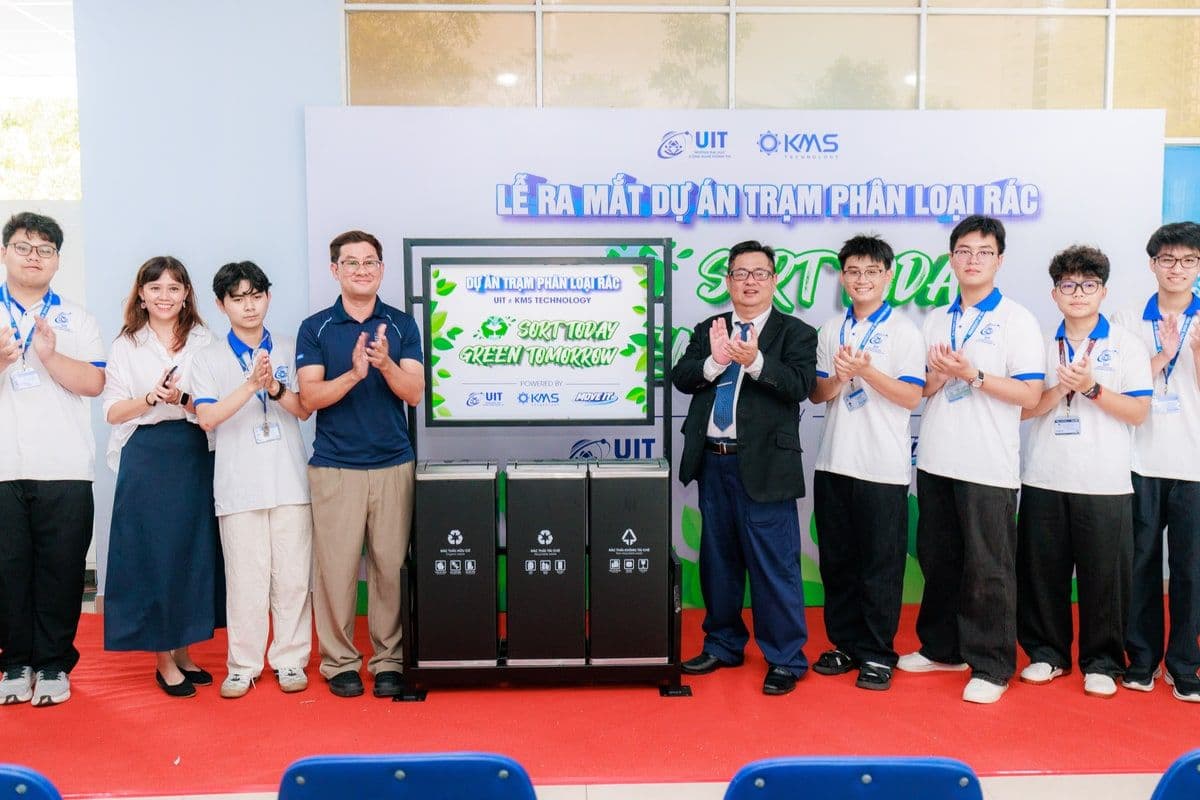


UIT x KMS Technology Green Sorting Stations: A Greener Choice for Every Day on Campus
05-09-2026
UIT x KMS Technology Green Sorting Stations: A Greener Choice for Every Day on CampusOn September 4, 2026, the University of Information Technology, Vietnam National University Ho Chi Minh City (UIT), in collaboration with KMS Technology, held the inauguration ceremony for the UIT x KMS Technology Green Sorting Station Project. With the message “Sort Today. Green Tomorrow,” the project officially began operating across the UIT campus.Representing KMS Technology at the ceremony was Mr. Tran Duc Duy, Communications Director of KMS Technology. Representing UIT were Assoc. Prof. Dr. Nguyen Tan Tran Minh Khang, Secretary of the Party Committee and President of UIT, along with faculty members and students.The Green Sorting Station Project was developed to make waste sorting more accessible and convenient for students as part of their everyday campus life. Each station features clear, easy-to-recognize signage for different waste categories, including recyclables, organic waste, and general waste.Speaking at the ceremony, Assoc. Prof. Dr. Nguyen Tan Tran Minh Khang highlighted the importance of practical actions in creating a greener and more sustainable learning environment. He shared: “The modern and well-designed green sorting stations across the UIT campus will contribute to a more civilized and environmentally responsible learning environment. We sincerely thank KMS Technology for partnering with UIT on this meaningful project, bringing practical improvements to our campus while inspiring a greener lifestyle among our students.”From today, the sorting stations will become part of the daily learning and campus experience of UIT students. The project also provides dedicated collection points for electronic waste, including used batteries, electronic components, computer mice, keyboards, earphones, cables, and damaged electronic devices.From the industry partner’s perspective, Mr. Tran Duc Duy, Communications Director of KMS Technology, shared the company’s aspiration to bring sustainable practices closer to students: “Through the Green Sorting Station Project, KMS hopes to accompany UIT in creating a greener and more sustainable educational environment for the young talents studying at the University.”Beyond transforming the campus environment, the project aims to encourage new habits among UIT students, making waste sorting a natural part of everyday life. Representing UIT students, Bui Dang Nhat Nguyen shared: “The presence of waste sorting stations across the campus serves as a reminder for every UITer to develop the habit of sorting waste and embrace a more environmentally responsible lifestyle. Through small individual actions, every member of the UIT community can contribute to our shared commitment to a greener environment.”KMS Technology’s partnership in this project further strengthens the connection between the University and industry, extending beyond technology to initiatives that create positive value for the community and the environment.“SORT TODAY. GREEN TOMORROW.”A small action can become a new habit. And when that habit is practiced every day across the UIT community, small changes can come together to create a greener and more sustainable campus.


UIT x AvePoint: Promoting a Green Lifestyle, Building a Sustainable Learning Environment
05-09-2026
On the morning of September 4, 2026, the University of Information Technology, Vietnam National University Ho Chi Minh City (UIT) held an inauguration ceremony for the UIT x AvePoint drinking water station system, officially putting the new facilities into service for students. Sponsored by AvePoint, the project provides students with greater access to drinking water while enhancing everyday amenities across the UIT campus.Representing AvePoint at the ceremony were Mr. Harry Li, AvePoint Vietnam Country Manager, and Ms. Jasmine Dinh, AvePoint Vietnam General Manager. Representing UIT were Assoc. Prof. Dr. Nguyen Tan Tran Minh Khang, Secretary of the Party Committee and President of UIT, along with representatives from the University’s units, faculty members, and UIT students.The drinking water stations have been installed at convenient locations across the campus, allowing students to easily refill their water bottles throughout the day. Beyond providing a practical campus amenity, the initiative encourages students to bring reusable bottles and gradually reduce their reliance on single-use plastic bottles.At the ceremony, representatives of UIT and AvePoint jointly performed the ribbon-cutting ceremony, officially inaugurating the new drinking water station system. Representatives from both sides then used the stations for the first time, marking the beginning of their everyday use as part of UIT’s learning and campus environment.Through this initiative, UIT and AvePoint aim not only to provide a practical facility for students but also to inspire simple, environmentally friendly habits across the UIT community. Each refill and each reusable bottle can be a small step toward reducing plastic waste and fostering a greener, more sustainable campus.The UIT x AvePoint drinking water station system also reflects the shared commitment of the University and its industry partner to creating a student-centered learning environment where technology, community well-being, and sustainability go hand in hand.SDG 4 – Quality Education

FROM UIT TO SINGAPORE AND INDONESIA: 18 DAYS TO SEE THE WORLD FROM A WIDER PERSPECTIVE
18-08-2026
“I packed 20 kilograms of luggage for 18 days, but came home carrying far more than I had brought.”In July 2026, Huynh Ngoc Bao, a student from the Faculty of Computer Science at the University of Information Technology, Vietnam National University Ho Chi Minh City (UIT), embarked on a journey to Singapore and Indonesia to participate in the ASEAN Summer @NTU Programme 2026.Eighteen days, two countries, two learning environments, and friendships with people from diverse cultural backgrounds transformed an international summer program into something far more meaningful. For Bao, it became a journey that broadened his perspective on technology, deepened his understanding of the value of community, and, most importantly, showed him that young people sometimes discover their true limits only after finding the courage to step beyond them.A Journey into the UnknownBefore departing, Bao imagined that the ASEAN Summer @NTU Programme 2026 would resemble many other international academic programs: lectures, workshops, group projects, and field trips.His suitcase, limited to 20 kilograms, contained everything he would need for the next 18 days. In his mind, however, there was a mixture of excitement and uncertainty as he prepared for his first academic journey across two countries — wondering about the new environments, the people he would meet, and his own ability to adapt.Yet it was precisely those unknowns that made the journey worthwhile.His first destination was Nanyang Technological University (NTU Singapore), where Bao explored topics ranging from the circular economy and renewable energy to smart cities through lectures, workshops, and experiential learning activities.Subjects that initially seemed distant from computer science gradually became relevant when placed in the context of real-world challenges: How can waste become a raw material for new products? What role could water-based batteries play in future energy systems? How can reinforcement learning enable air-conditioning systems to operate more intelligently and efficiently?Bao began to realize that the knowledge he was acquiring did not exist in isolation within a single discipline.An algorithm could contribute to energy efficiency. Data could reshape how a city operates. A technological solution could create environmental and social impacts far beyond its original technical purpose.The question was no longer simply, “How does this technology work?”It became, “What problem can this technology solve for people?”That marked the first significant shift in how Bao viewed the field he had chosen to pursue.From Singapore to Yogyakarta: Two Places, Two Approaches to Creating ChangeIf Singapore showed Bao how science and technology could be deployed within a highly developed urban environment, his next destination — Yogyakarta — offered a very different perspective on innovation.At Universitas Gadjah Mada (UGM), the learning journey continued, but in a new context. Through experiential activities and an exploration of local waste-management practices, Bao observed how environmental challenges could be addressed by solutions rooted in the needs and resources of local communities.The contrast between the two destinations left a strong impression on him.In Singapore, Bao witnessed the power of technology, infrastructure, and the ability to implement solutions at scale. In Yogyakarta, he discovered the strength of grassroots initiatives — solutions shaped by everyday realities and driven by direct community participation.Though seemingly different, the two experiences ultimately led to the same question: What makes a solution truly sustainable?For Bao, the answer gradually became clearer. A solution does not necessarily need to be highly complex or built on the most advanced technology to create meaningful impact. What matters is whether it fits the local context, addresses the right problem, and is accepted by the community it is designed to serve.From lectures at NTU to community-based experiences in Yogyakarta, Bao began to see more clearly the connection between technology and people. Technology may provide the tools to solve problems, but human needs and social contexts ultimately determine whether those tools can create genuine value.For a Computer Science student, this was a lesson that extended far beyond the 18 days of the summer program. It could influence how he approaches the design and development of technology products in the years ahead.When Strangers Become Part of the JourneyHad the ASEAN Summer @NTU Programme 2026 consisted only of lectures and field trips, it would still have been a memorable academic experience.What made the journey truly special for Bao, however, were the people he met along the way.On the first day, they arrived as strangers. Each person brought a different academic background, culture, communication style, and set of experiences.Gradually, those differences became bridges rather than barriers.They worked together to solve problems, debated ideas, divided responsibilities for group projects, and learned to reach common ground despite approaching the same issue from different perspectives.Skills that might seem familiar — communication, teamwork, active listening, and critical thinking — took on entirely new dimensions in a multicultural environment.Bao learned not only how to express his ideas clearly enough for others to understand, but also how to listen carefully enough to understand why someone else might see the same problem from an entirely different perspective.And friendships were built far beyond the classroom.There were days spent exploring Singapore and Yogyakarta together, cultural exchanges, outdoor activities, shared meals, and conversations that were never part of the official schedule.They talked about their universities, hometowns, daily lives, and aspirations for the future. Through these ordinary conversations, a much larger world gradually unfolded before Bao — not through maps or textbooks, but through the people sitting beside him.At that point, an “international experience” was no longer simply about a Vietnamese student studying in Singapore or Indonesia.It was about learning how to live, study, and work alongside people whose backgrounds and perspectives were different from his own.You Do Not Have to Be Perfect Before Stepping into the WorldThe 18-day journey also gave Bao an opportunity to reflect on himself.In an international environment, young people may easily feel that they are not skilled enough, confident enough, or sufficiently prepared. But with each day of learning and new experiences, Bao came to realize that no one needs to know everything before taking the first step.“You don’t have to wait until you are perfect before stepping into an international environment. What matters more is taking initiative, being willing to learn, adapting to change, and having the courage to step outside your comfort zone.”The knowledge and skills Bao had developed during his studies at UIT provided a strong foundation for participating in academic activities and collaborative projects. The international environment, however, placed those capabilities in an entirely new context — one that required him to take greater initiative, adapt more quickly, and remain open to learning from those around him.What Bao brought home, therefore, was not the feeling that he had somehow become “good enough” after 18 days.Instead, he returned with a clearer understanding of what he still needed to improve — and greater confidence that those gaps could be filled through continued learning and experience.Perhaps this is also one of the most important values that international learning opportunities can offer UIT students. Each journey does more than add another destination to the map. It places students in an environment different enough to encourage them to reassess their abilities, perspectives, and aspirations.The Suitcase HomeAfter 18 days, the journey came to an end.The lectures concluded. Group projects were completed. Field trips became photographs stored on phones. Friends who had studied and explored two cities together returned to their own universities, countries, and individual paths.Bao returned to Vietnam as well.His suitcase could still carry no more than 20 kilograms, but what he brought home with him was far greater than what he had packed at the beginning.He returned with a broader perspective on technology — one in which a Computer Science student looks beyond algorithms and systems to consider the people and social impact behind every technological solution.He returned with lessons from two destinations: Singapore demonstrated the power of technology and solutions implemented at scale, while Yogyakarta showed how community-driven initiatives can also create meaningful and lasting change.He returned with friendships formed among people who had once been complete strangers, along with greater confidence in his ability to learn, adapt, and connect in an international environment.Above all, he returned with a new understanding of what it means to step outside one’s comfort zone: there is no need to wait until everything is perfect before beginning.The ASEAN Summer @NTU Programme 2026 lasted only 18 days. But the lessons from Bao’s journey through Singapore and Indonesia are likely to remain with him for much longer.Because sometimes, the greatest value of a journey is not measured by how far we travel.It is measured by how differently we see the world — and ourselves — when we return.

UIT Expands Partnership Program in Computer Engineering with the University of Newcastle
29-10-2024
On the morning of October 21, at the University of Information Technology (UIT), Vietnam National University - Ho Chi Minh City (VNU-HCM), a cooperation agreement signing ceremony took place between UIT and the University of Newcastle (UON), Australia. This event marks a significant milestone in UIT’s international collaboration efforts, promising to bring numerous learning and development opportunities to UIT students.
Attending the event from UON were Professor Ken Anderson, Deputy Vice-Chancellor for External Relations & International Cooperation; Associate Professor Duy Ngo, Program Coordinator for Computer Engineering; and Ms. Phoebe Pham, UON’s Vietnam Admissions Manager.
Representing UIT in welcoming and working with the UON delegation were Assoc. Prof. Dr. Nguyen Hoang Tu Anh, President; Assoc. Prof. Dr. Nguyen Luu Thuy Ngan, Vice President; Dr. Nguyen Minh Son, Head of the Computer Engineering Department; and M.A. Le Ngo Thuc Vi, Head of the Office for Special Programs.
UIT and UON Representatives Sign Cooperation Agreement
During the ceremony, both parties signed a Memorandum of Understanding (MoU) emphasizing the development of joint training programs in Computer Engineering, student exchanges, and scientific research cooperation. The MoU opens up many benefits for UIT students, particularly in accessing UON’s international training programs. The student exchange programs between the two universities allow UIT students opportunities for short- or long-term study in Australia and at UON’s Singapore campus, providing them with a rich, international learning and cultural experience.
The Meeting Atmosphere was Open and Cordial
At the ceremony, Assoc. Prof. Dr. Nguyen Hoang Tu Anh, President of UIT, remarked: “This signing ceremony marks a significant milestone for both UON and UIT in academic collaboration, especially in the Computer Engineering program. This agreement takes our partnership to an important new level, encouraging and inspiring Vietnamese students to focus on Computer Engineering at undergraduate levels. This step aligns with UIT's internationalization strategy, affirming our commitment to providing the best value for our students."
The Signing Ceremony Marks a Significant Milestone in UIT and UON's International Partnership in Education
The signing of the MoU between UIT and UON is not only a key milestone in UIT’s development journey but also a stepping stone for UIT students to broaden their horizons globally. The learning, research, and skill development opportunities that UON offers will help UIT students excel in their studies and become confident, dynamic global citizens in this era of international integration.
Assoc. Prof. Dr. Nguyen Hoang Tu Anh Presents Souvenir to UON Delegation
Additionally, the delegation from the University of Newcastle had the chance to tour UIT’s "Green Campus." This area not only serves as a study space but also offers students an ideal environment for relaxation and recharging after intensive study sessions. UON representatives expressed their admiration for UIT’s modern facilities, along with the green space that enhances the student learning experience.
After the meeting, the University of Newcastle delegation enjoyed a campus tour at the University of Information Technology.
The University of Newcastle is a public university in Australia, established in 1965 and attracting a large number of international students. It ranks among Australia’s top 10 universities with the highest doctoral rates. The University offers diverse programs across many fields and ranks 8th in Australia for research of “above world standard.” UON also has strong ties with the Australian government and houses the Hunter Medical Research Institute (HMRI), one of Australia’s most significant research fields with a meaningful impact on global cybersecurity.
Photo: UIT Media Club

Uni Tour 2024: International School Students Enthusiastic about AI and IOT Knowledge
09-04-2024
Continuing the Uni Tour 2024 series, Pacific Horizon School (PHS) - TH, THCS & THPT had a visit and exploration of the learning environment at the University of Information Technology (UIT) on the morning of April 3, 2024.
No longer virtual tours online or images in books, over 150 students from Pacific Horizon School (PHS) - TH, THCS & THPT had the opportunity to experience the real green campus and modern facilities at UIT: from spacious lecture halls to state-of-the-art laboratories, and smart classrooms.
Students visited the IoT Laboratory
Additionally, Uni Tour 2024 also provided opportunities for students to meet, exchange, and listen to experts' sharing on "hot" fields such as Artificial Intelligence (AI), IoT, and Information Security. From there, students gained more knowledge about the industry, had their questions answered to have a clearer picture of future career paths.
In Hall E, Assoc. Prof. Dr. Le Trung Quan - Dean of the Computer Network & Communication Faculty shared with students about IoT and Information Security. This is a field with strong development potential in the Industry 4.0 revolution, where internet security and personal data protection are becoming crucial problems to solve.
Assoc. Prof. Dr. Le Trung Quan shared about IoT and Information Security
Moreover, Dr. Nguyen Vinh Tiep - Head of the Multimedia Communications Laboratory (MMLab) also provided insights into Artificial Intelligence and future career opportunities in this field. Artificial Intelligence is gradually becoming a powerful tool serving humans and receiving much attention from students.
Dr. Nguyen Vinh Tiep also provided insights into Artificial Intelligence
Student Phan Duy Minh, an 11th-grade student at Pacific Horizon School (PHS) - TH, THCS & THPT, shared, "Through today's visit and listening to the teachers' introduction about AI or IoT, I have a different perspective on Information Technology and I wish to learn more in the future."
Students asked questions related to majors at UIT
At the end of the program, students learned about UIT's international cooperation programs with a dynamic environment and international qualifications. Many students asked questions to Ms. Nguyen Thi Le Thuan - in charge of the BCU enrollment program in Vietnam about this program and received detailed explanations.
Uni Tour 2024 is part of the activities of the "UIT Student Ambassadors 2024" program, aiming to provide high school students with the opportunity to directly experience the facilities and quality of education at the University of Information Technology, Ho Chi Minh City. The program helps students to have a clearer understanding of the environment and training programs of the University. From there, students have a basis to make accurate decisions about their future majors.
Here are some images of the tour activity:
For more details, visit: https://tuyensinh.uit.edu.vn/uni-tour-2024-hoc-sinh-truong-quoc-te-hao-hung-voi-kien-thuc-ve-ai-iot
Ha Bang - Media Collaborator, University of Information Technology
Nhat Hien - Translation Collaborator, University of Information Technology

UNI Tour 2024: Welcoming Teachers and Students from Pacific High School on April 3, 2024
30-03-2024
"UNI TOUR 2024" is an extremely attractive and exciting program within the series of activities of the "UIT Student Ambassador 2024", aiming to provide high school students with the best opportunity to experience firsthand the facilities and training quality of University of Information Technology.
It's not just virtual tours online or images in books anymore; students will have the chance to visit facilities ranging from spacious classrooms, modern laboratories to green campuses with a plethora of Instagram-worthy spots.
Moreover, "Uni Tour 2024" is also an opportunity for students to exchange ideas and listen to experts discussing about careers, answering questions related to the fields of information technology and communication. Students can gain better access to accurate information, admission criteria, and privileges when becoming UIT students.
Register now for a "UIT UNI TOUR 2024" visit - what you'll receive is not just experiences and practical evaluations of the school, but also an opportunity to express your thoughts, questions, and concerns about the future and career choices.
And who knows, after this journey, you might find that "UIT is all you need". Well, then there's no other choice but to register as a new student of the university.
So, are you eager to "pack your bags and go" to visit UIT? If so, hurry up and register, because you wouldn't want to miss this valuable opportunity. See you soon!
For more details, visit: https://www.facebook.com/TuyenSinh.UIT/posts/pfbid04VFvXWMdxY67Eo3rUA93sN7pg5z6wwsi6pm6PcgjmaJ5ZugYqoGHqmNDqBhVEeGYl
Ha Bang - Media Collaborator, University of Information Technology
Nhat Hien - Translation Collaborator, University of Information Technology

UniTour: Over 150 Dak Nong Students Explore UIT for an Exciting Day
25-03-2024
On the afternoon of March 16th, over 150 students from Nguyen Chi Thanh Specialized High School in Dak Nong had an exciting excursion at the University of Information Technology, VNU-HCM (UIT). This activity was part of the UniTour 2024 program designed for high school students who are passionate about information technology and communication.
At UIT, students explored the green campus with modern facilities, convenient classrooms, lecture halls, and advanced laboratories. Then, they moved to Hall E to listen to experts' insights into the field of information technology and communication and to discuss issues they were curious about. Through this, students gained a clearer understanding of the "career path" they might take in the future.
The students visited the smart classrooms at UIT
At the hall, students delved deeper into Artificial Intelligence (AI), its applications in daily life, and future job opportunities through a sharing session by Mr. Nguyen Vinh Tiep - Head of the Multimedia Lab: "Artificial Intelligence is identified as one of the key sectors, part of the national strategy on research, development, and application of AI, and is one of UIT's important tasks, training high-quality human resources," shared Mr. Tiep.
Mr. Nguyen Vinh Tiep introduced the field of Artificial Intelligence to the students.
Besides, the field of Integrated Circuit Design - a promising sector in the future - was introduced to students by Mr. Ta Tri Duc, a lecturer at the Computer Engineering Department. This field holds immense potential as integrated circuits are a crucial foundational element in the digital transformation process.
Mr. Ta Tri Duc shared insights about Integrated Circuit Design at UIT.
Furthermore, Ms. Nguyen Thi Le Thuan - Head of BCU Admissions in Vietnam, provided information about the international cooperative training program (BCU) with a dynamic and high-quality environment offering international qualifications. At the end of the program, many students asked questions about UIT, the international cooperative program, and future job opportunities in the field of information technology.
Small gifts were given to the students from the international cooperative training program.
Uni Tour 2024 is part of the activities of the "UIT Student Ambassadors 2024", aimed at providing high school students with the opportunity to directly experience the facilities and quality of education at the University of Information Technology, VNU-HCM. The program helps students better understand the environment and training programs of the university, thereby providing a basis for making accurate decisions regarding their future academic paths.
Some images from the tour:
Như Ý
English version: Phan Huy Hoang

High School Students Enthusiastic about Activities of "UNI TOUR 2024
18-02-2024
Uni Tour 2024," organized by the University of Information Technology, VNU-HCM, has officially launched with many exciting and interesting activities for high school students. This is an opportunity for students to experience, visit, and directly explore the learning environment, gaining a better understanding of various careers in the field of information technology.
At "Uni Tour 2024," high school students will have the chance to visit the facilities, from spacious classrooms to modern laboratories, and explore the green campus with a variety of Instagrammable spots.
Moreover, "Uni Tour 2024" is also an opportunity for students to interact and listen to experts discussing professions, addressing questions related to the fields of information technology and communication. Students can gain a clearer understanding of accurate information, admission procedures, selection criteria, and the privileges of becoming UIT students.
To register for the program, high schools can contact the phone number 090.883.1246 (contact Mr. Khanh) for assistance.
For more details, visit: UIT Admissions Facebook Video Link
Written by: Ha Bang
Translated by: Ngoc Diem

"UNI TOUR 2024": Journey to Explore UIT - The Dream University
15-01-2024
"Uni Tour 2024," organized by the University of Information Technology, VNU-HCM, has officially launched with numerous engaging and exciting activities for high school students. This is an opportunity for students to experience, visit, and directly explore the learning environment and gain a deeper understanding of various fields in information technology.
At "Uni Tour 2024," students will have the chance to explore the extensive educational facilities, from spacious classrooms to modern laboratories, and the green campus with a myriad of picturesque corners.
Additionally, "Uni Tour 2024" is an opportunity for students to interact and listen to experts discussing professions, answering questions related to the fields of information technology and communication. Students can gain a clearer understanding of accurate information, admission procedures, admission criteria, and the privileges of becoming UIT students."The eyes see more than a hundred hearings." Now, students can experience firsthand the paths, buildings, classrooms, and virtual corners at UIT.
To register for the program, high schools are advised to contact the phone number 090.883.1246 (contact Mr. Khanh) to receive assistance.
Detailed Information: https://tuyensinh.uit.edu.vn/uni-tour-2024-hanh-trinh-kham-pha-uit-ngoi-truong-dai-hoc-dang-mo-uoc
Hạ Băng - Media Collaborator, University of Information Technology
English version: Phan Huy Hoang