
Partnerships for the goals
SDG17



UIT – VNGGames Launch Roblox Game Development Course, Bringing Student-Created Games to Global Players
16-09-2026
On September 16, 2026, the University of Information Technology, Vietnam National University Ho Chi Minh City (UIT) and VNGGames officially launched the “Game Development on Roblox” course, opening a new industry-integrated learning pathway centered on real products and real-world markets.Over three months, 42 students will learn alongside 14 VNGGames experts and experience the full game development journey – from ideation and development to testing and product refinement. Most notably, final projects will have the opportunity to be published directly on Roblox, bringing games developed by UIT students to players around the world.42 students, 14 experts, and three months to build a real productWhat sets the “Game Development on Roblox” course apart is its product-centered approach. Rather than focusing solely on learning individual tools or completing separate assignments, students take part in a comprehensive game development process – from developing concepts and designing gameplay to building product components, testing, gathering feedback, and continuously refining their games.Throughout the three-month program, 42 students will follow a curriculum developed and delivered directly by 14 experts from VNGGames. Their active involvement in the classroom gives students access not only to technical knowledge, but also to hands-on industry experience, professional workflows, and product development thinking from the game industry.This is also the first time a university in Vietnam has partnered with VNGGames to integrate a hands-on Roblox game development course into its formal curriculum, creating another model for connecting academic knowledge directly with technology, products, and the market.When a course project has the opportunity to reach real playersOne of the program’s key goals is for each student team to complete its own game by the end of the course. These projects will have the opportunity to be published directly on Roblox and reach a global community of players.This significantly changes what a classroom project can mean. When a game is developed not simply for a presentation or a grade, but with the potential to appear on a real-world platform, students need to think more deeply about player experience, product quality, performance, and feedback from the community.It also gives students a clearer understanding of what it takes to bring a technology product from an initial idea to its users. Every feature that needs to be revised, every gameplay mechanic that requires adjustment, and every change made after testing becomes part of the learning experience.Building on the UIT – VNG co-education modelThe opening ceremony was attended by Dr. Nguyen Thai Binh Long, Deputy Head of the Department of External Relations and Project Development, VNU-HCM.Representing VNGGames were Mr. Kelly Wong, Chief Executive Officer of VNG Group; Mr. La Xuan Thang, Director of Online Game Publishing; Mr. Duong Chi Tam, Head of Roblox; together with VNGGames experts who will directly participate in delivering the program.The “Game Development on Roblox” course further advances the University – Industry – Learner collaboration model that UIT and VNG have developed over recent years.Prior to this program, the two sides jointly implemented SE116 – Practical Game Programming Skills Development, integrating the company’s Game Development Fresher program with UIT’s game development curriculum. In 2026, SE116 returned for its second season.While SE116 enables students to experience game development workflows and learn directly from industry experts within a formal course, the Roblox program takes that experience one step further by connecting students with a platform that serves a global user community and placing the final product at the center of the learning process.Bringing industry into the classroom, bringing career experience closer to studentsThe direct involvement of industry experts turns the classroom into a meeting point between academic knowledge and professional practice. UIT provides the academic foundation and learning environment; VNGGames contributes technology, product development expertise, and real-world industry insights; and students transform what they learn into products of their own.With this approach, students do not have to wait until an internship or graduation to experience how real products are developed. Teamwork, problem-solving, responding to feedback, refining a product, and taking responsibility for the final outcome all become part of the learning process itself.This is also how UIT is gradually expanding learning beyond the boundaries of the traditional classroom. Industry collaboration is not simply an extracurricular activity; it can be integrated directly into formal education, allowing students to strengthen their professional foundations while gaining an early understanding of workplace expectations. From UIT classrooms to a global community of playersRoblox brings a distinctive dimension to the course: the possibility of taking student projects from an academic environment to a platform with real users. For students, this is both an opportunity and a challenge, as their games may move beyond the classroom and receive feedback from a much broader community of players.Through this process, students can gradually develop a product mindset rather than focusing solely on fulfilling technical requirements. A game may begin with lines of code written in a UIT classroom, but reaching real users requires much more – creativity, collaboration, experimentation, refinement, and continuous improvement.With 42 students, 14 VNGGames experts, and three months of intensive collaboration, the “Game Development on Roblox” course adds a new dimension to practice-oriented education at UIT, giving students the opportunity to transform knowledge into real products and bring those products closer to the market.The “made by UIT students” games that may appear on Roblox in the months ahead will therefore represent more than the outcomes of a single course. They will reflect a learning journey in which the University, industry, and students work together to create educational experiences closely connected with real-world practice.

SE116 Returns with UIT – VNG: Bringing Real-World Game Development Experience into the Classroom
16-09-2026
On the afternoon of September 10, 2026, the University of Information Technology, Vietnam National University Ho Chi Minh City (UIT) and VNG officially launched the new season of SE116 – Practical Game Programming Skills Development. Following its first year of implementation, the course continues to bring industry experts, product development processes, and real-world challenges from the game industry directly into the classroom, further advancing the “Three-Party” collaboration model among University – Industry – Learners in technology education.When the classroom moves closer to the real workplaceIn SE116, students do more than learn game programming through lectures. They take part in the actual process of developing a product. From generating ideas and forming teams to assigning responsibilities, writing code, testing, receiving feedback, and refining their projects, every stage places students in situations that closely reflect how a real game development team operates.The course combines the Game Development Fresher (GDF) program of ZPS – VNG with UIT’s game development curriculum. The University provides the academic foundation and organizes the learning process, while industry experts bring practical experience, product development workflows, and real-world requirements into the classroom. Students are at the center of the model, learning by doing and taking responsibility for the products their teams create.This approach allows learning to go beyond simply acquiring knowledge. When a piece of code does not work as expected, a feature needs to be redesigned, or team members must agree on an implementation strategy, students are simultaneously developing problem-solving, teamwork, project management, and feedback skills – essential capabilities for their future careers.University – Industry – Learners: working together in educationThe program was attended by Dr. Nguyen Thai Binh Long, Deputy Head of the Department of External Relations and Project Development, VNU-HCM; Assoc. Prof. Dr. Vu Duc Lung, Vice President and Deputy Secretary of the Party Committee of UIT; Mr. Kelly Wong, Chief Executive Officer of VNG Group; Mr. Nguyen Vu Tien, Deputy Director of Online Game Development at VNG ZingPlay Game Studios and Program Director; together with representatives from VNG, UIT faculty members, and students.At the event, Assoc. Prof. Dr. Vu Duc Lung highlighted UIT’s direction of strengthening the connection between academic education and industry practice, thereby creating more opportunities for students to engage with real-world challenges, apply their professional knowledge, and gain valuable workplace experience while still at university.From the industry side, VNG continues to support SE116 through a team of experts who participate directly in the program. By bringing experience from real game development projects into the classroom, these experts help students understand not only how a game product is created, but also the requirements, professional standards, and collaborative workflows of a technology company.A distinctive feature of the “Three-Party” model is that students are not merely the final beneficiaries. They actively participate in creating products, asking questions, testing solutions, receiving feedback, and strengthening their capabilities through each project. In this way, collaboration between the University and industry is transformed into tangible learning experiences that students can access directly in the classroom.From learners to mentors for the next generationThis year’s SE116 also introduces another meaningful continuation: students who completed the course in the previous season are returning as mentors to support the next cohort.The experiences they gained while developing their own projects – from debugging code and revising solutions to coordinating responsibilities among team members – now become practical insights that can be shared with new learners.The return of former students as mentors also creates a cycle of knowledge sharing within the student community. Knowledge and experience do not end with a single semester; they continue to be shared, enriched, and passed on from one generation of students to the next.As a result, current students can learn not only from faculty members and industry experts but also from mentors who have recently gone through the same journey they are now beginning.Bringing industry into the classroom, bringing students closer to their careersIn technology, the gap between classroom knowledge and market requirements can change rapidly. Deeper industry involvement in education therefore creates opportunities for curricula to stay connected with real-world practice while helping students identify the skills and capabilities they need to develop early in their academic journey.SE116 demonstrates how UIT is expanding its industry-integrated education model. Rather than waiting until an internship to experience a professional working environment, students can engage with part of the product development process within a formal course, work alongside industry experts, and receive feedback on the products they build themselves.A completed game project, therefore, is more than a final course outcome. The journey of creating it is equally important. Throughout that process, students gain a clearer understanding of their own capabilities, identify areas where they still need to improve, and become more familiar with the real-world expectations of the careers they may pursue after graduation.The continuation of SE116 in the 2026–2027 academic year also illustrates how university–industry collaboration can extend beyond company visits, seminars, or recruitment activities. When industry professionals participate directly in education, faculty members connect academic knowledge with practice, and students create real products themselves, the classroom becomes a meeting point for knowledge, technology, and the labor market.This is also one of the directions UIT continues to advance to create more opportunities for students to learn through practice, gain professional experience, and become better prepared for careers in the technology industry.

Chinese Ministry of Education Delegation Visits UIT to Explore Research Activities
16-09-2026
Chinese Ministry of Education Delegation Visits UIT to Explore Research ActivitiesOn September 14, 2026, the University of Information Technology, Vietnam National University Ho Chi Minh City (UIT) welcomed a delegation from China’s Ministry of Education for a working visit and tour of the University’s ASIC Laboratory (ASIC LAB).The delegation was led by Mr. Wang Chengwen, a member of the Party Leadership Group of China’s Ministry of Education and head of the Discipline Inspection and Supervision Team of the Central Commission for Discipline Inspection and the National Commission of Supervision stationed at the Ministry of Education. The delegation also included officials from China’s Ministry of Education and representatives of Chinese diplomatic missions in Vietnam.Representing UIT at the meeting were Assoc. Prof. Dr. Vu Duc Lung, Deputy Secretary of the Party Committee and Vice President of UIT; Dr. Nguyen Minh Son, Dean of the Faculty of Computer Engineering; and Assoc. Prof. Dr. Le Dinh Duy, Head of the Office of Science, Technology, External Relations and Postgraduate Affairs. Exploring UIT’s research environment at ASIC LABAs part of the visit, the delegation toured ASIC LAB, a facility supporting education, research, and development in integrated circuit design at UIT.The delegation was introduced to the laboratory’s research environment, facilities, and specialized academic activities, gaining an overview of UIT’s efforts in advanced technology education and research, particularly in integrated circuit design.A highlight of the visit was the opportunity to hear directly from UIT students and researchers, who presented research projects and technology products currently being developed at the laboratory.Through these presentations, the delegation gained a closer look at the research outcomes being developed at UIT, while the students and researchers demonstrated their initiative, technical capabilities, and growing expertise in integrated circuit design. Strengthening international connections in education and researchWith its commitment to developing high-quality human resources in information technology and emerging technologies, UIT continues to invest in education, research, and the development of strategic technology fields, including integrated circuit design.Visits and academic exchanges with international delegations also provide opportunities for UIT to strengthen connections and introduce its education and research environment to international partners and organizations, contributing to broader academic and research engagement beyond Vietnam.

UITGoGlobal | 30 Days at NUS: From UIT to One of Asia’s Leading Academic Environments
09-09-2026
Thirty days, five courses, an entirely new academic environment, and countless first-time experiences. For Nguyen Van Minh, a Computer Science student in the 2023 Talent Program at the University of Information Technology, Vietnam National University Ho Chi Minh City (UIT), his first month at the National University of Singapore (NUS) has been more than a period of adjustment. It has also been a chance to discover new boundaries and challenge himself beyond what he already knows.Participating in the DiscoverNUS exchange program during Semester 1 of the 2026–2027 academic year, Minh has the opportunity to study, explore research, and experience student life in an international environment where every day brings new expectations for independent learning, critical thinking, and initiative.30 days of learning to adaptThe first days in Singapore were not entirely easy. A new pace of life, a multicultural environment, different learning approaches, and a demanding workload sometimes required Minh to slow down, reassess, and find his own way to adapt.Yet those differences soon became some of the most valuable parts of the experience.From navigating unfamiliar routines, Minh gradually learned to organize his schedule, manage his time, connect with international friends, and become more proactive in making the most of each opportunity. Even simple moments, such as exploring local food with friends or chatting after class, helped turn an unfamiliar environment into a place that gradually felt more like everyday life.“From being unfamiliar with the local food and lifestyle at first, sharing local dishes with friends has now become one of the most memorable parts of my first month here,” Minh shared.When a Computer Science student steps beyond technology’s “comfort zone”One of the most valuable aspects of Minh’s experience at NUS has been the academic program itself.This semester, Minh is taking five courses spanning image processing, data mining, Generative AI, AI governance, and history. This combination allows him to explore technology not only from a technical perspective but also through its connections with business, governance, and society.Through EE4704 – Image Processing and Analysis and BT4222 – Mining Web Data for Business Insights, Minh continues to strengthen his knowledge of image processing, computer vision, and web data mining.Meanwhile, IS4401 – Generative AI and Business Applications and IS4246 – Smart Systems and AI Governance raise broader questions: How can AI be effectively applied in real-world contexts? How should intelligent systems be developed and governed to ensure responsibility, transparency, and sustainable value?GEC1037 – Big Picture History adds a distinctly different dimension, taking a Computer Science student beyond familiar technical problems and encouraging him to consider technological development within the broader context of history and society.This interdisciplinary approach is helping Minh realize that technical expertise is essential for going further in technology, but it is not enough on its own. Technology professionals also need to understand the issues their work affects and the responsibilities that come with every solution they create.Beyond coursework: proactively seeking research opportunitiesAlongside his courses, Minh is actively seeking opportunities to engage in research at NUS, particularly in areas that interest him, including Edge Device Systems, Transformer architectures, and Reinforcement Learning.For Minh, research is not simply another experience to add to his academic profile. Entering a new research environment gives him an opportunity to observe how international research teams formulate questions, develop ideas, exchange academic perspectives, and gradually turn research questions into tangible outcomes.The foundation Minh has developed through UIT’s Talent Program in Computer Science has also given him greater confidence as he enters a new academic environment. At the same time, the experience is helping him identify the skills and knowledge he still needs to strengthen if he wishes to pursue advanced research in the future.An international semester that goes beyond the classroomBeyond lectures and coursework, Singapore itself has become another classroom for Minh.Trekking through green spaces, exploring Merlion Park and Marina Bay, experiencing the Singapore Night Festival, and simply spending time with friends from different countries have given him new ways to understand the place he now calls home for the semester.More importantly, studying and working alongside people with different cultural backgrounds, experiences, and ways of thinking has encouraged Minh to listen, communicate, and adapt. These are skills that cannot be fully developed through textbooks alone, yet they are essential for students aspiring to participate in global academic and professional environments.From UIT to NUS: opening another door to the worldLooking back on his first month, Minh believes that his years at UIT have provided him with an important foundation for entering a new academic environment with greater confidence.“I would like to express my sincere gratitude to the University of Information Technology, Vietnam National University Ho Chi Minh City, for providing me with a strong academic foundation, building my confidence, and creating opportunities for me to study at NUS. The knowledge and experiences I gained at UIT continue to accompany me throughout this journey,” Minh shared.Thirty days are only the beginning of a semester. Ahead are more challenging courses, research opportunities to pursue, and many experiences that cannot yet be anticipated.Perhaps that is precisely where the value of an international exchange lies. Students do not go abroad simply to see another university or experience another country. They step into a broader environment where they can reflect on what they already know, recognize what they still need to learn, and discover how far they want to go.From UIT to NUS, Nguyen Van Minh’s journey is also one of many stories of a generation of UIT students proactively stepping into the world with knowledge, capabilities, and a strong desire to learn.Wishing Minh a semester filled with meaningful experiences, memorable academic milestones, and many new stories to bring back to UIT from his DiscoverNUS journey!

University of Information Technology and OneCAD Vietnam Sign Memorandum of Understanding
08-09-2026
On the morning of September 4, 2026, the University of Information Technology, Vietnam National University Ho Chi Minh City (UIT) and OneCAD Vietnam officially signed a Memorandum of Understanding (MoU), marking a new step toward practical collaboration in education, research, innovation, and technology transfer.The partnership brings together UIT’s strengths in information technology and OneCAD Vietnam’s expertise in Autodesk solutions, Building Information Modeling (BIM), and digital transformation for the Architecture, Engineering, and Construction (AEC) industry. Through this collaboration, the two sides aim to advance research, technology experimentation, and real-world applications that bridge digital technologies with practical challenges in the built environment.Assoc. Prof. Dr. Nguyen Tan Tran Minh Khang delivers his remarks at the ceremony.At the ceremony, Assoc. Prof. Dr. Nguyen Tan Tran Minh Khang, President of UIT, and Mr. Doan Khac Tam, General Director of OneCAD Vietnam Co., Ltd., officially signed the MoU. The agreement lays the foundation for connecting UIT’s education and research capabilities with OneCAD Vietnam’s industry experience and technology ecosystem, thereby promoting research, developing high-quality human resources, and creating technology solutions for digital transformation.Mr. Doan Khac Tam shares his expectations for future collaboration.One of the key initiatives envisioned under the partnership is the BEI Lab – Bridging the Digital and Physical Built Environment. The Lab is expected to serve as a collaborative space where UIT faculty members and students can work alongside industry experts to conduct research, experiment with emerging technologies, and develop solutions with real-world applications.Students are also at the heart of this collaboration. Training programs, specialized seminars, research projects, and industry-based projects will provide them with more opportunities to engage directly with technology throughout their studies, gain a deeper understanding of real-world industry challenges, and explore interdisciplinary fields where information technology meets the built environment.With these concrete directions for collaboration, UIT and OneCAD Vietnam aim to foster an ecosystem connecting university, industry, research, and application – bringing knowledge and technology beyond the classroom and closer to the evolving needs of society.


WEAVING THE SOUNDS OF VIETNAM AT UIT: BRINGING TRADITIONAL CULTURE CLOSER TO TECHNOLOGY STUDENTS
07-09-2026
On September 4, 2026, the sounds of flutes, string instruments, drums, and other traditional instruments filled the campus of the University of Information Technology, Vietnam National University Ho Chi Minh City (UIT), as the school-based traditional music program “Dệt Thanh Âm Việt” (Weaving the Sounds of Vietnam) came to life.Held at the beginning of the new academic year, the program offered UIT students a distinctive cultural experience while contributing to the implementation of the spirit of Resolution No. 80-NQ/TW of the Politburo on the development of Vietnamese culture: fostering the holistic development of individuals, creating a human-centered cultural environment in educational institutions, and bringing arts and cultural heritage closer to younger generations.LETTING TRADITIONAL MUSIC BECOME A NATURAL PART OF STUDENT LIFEAt a university often associated with lines of code, artificial intelligence, data, and emerging technologies, “Dệt Thanh Âm Việt” brought a different rhythm to campus.Within the familiar surroundings of UIT, students had the opportunity to listen to traditional melodies, observe musical instruments up close, and discover how artists bring each distinctive sound to life.What made the program special was not simply the presence of traditional music on a university campus, but the way cultural heritage was introduced through an engaging and accessible experience for young people. Curiosity sparked by an unfamiliar instrument, a melody, or a performance technique could become the starting point for students to discover and better understand values passed down through generations.In this way, culture extends beyond textbooks and exhibition spaces. It can be experienced firsthand, woven naturally into campus life, and sustained through the curiosity and appreciation of younger generations.FROM THE SPIRIT OF RESOLUTION NO. 80-NQ/TW TO MEANINGFUL EXPERIENCES ON CAMPUSResolution No. 80-NQ/TW of the Politburo on the development of Vietnamese culture identifies culture and human development as a foundation, an important endogenous resource, and a driving force for the country’s rapid and sustainable development.The Resolution also emphasizes the importance of fostering healthy cultural environments across families, schools, society, and digital spaces; promoting the comprehensive development of Vietnamese people in ethics, intellect, physical well-being, and aesthetics; strengthening arts education in educational institutions; and creating opportunities for students to regularly engage in artistic activities and cultural heritage education.Inspired by this vision, “Dệt Thanh Âm Việt” goes beyond a traditional music performance. It translates broader directions for cultural development into a tangible and engaging university experience, giving students opportunities to encounter traditional arts, deepen their understanding of Vietnamese cultural identity, and cultivate an appreciation for preserving the nation’s cultural heritage.A TECHNOLOGY UNIVERSITY WHERE THE STUDENT EXPERIENCE GOES BEYOND TECHNOLOGYAs a higher education institution specializing in information and communication technology education and research, UIT is closely associated with science, innovation, and the technologies shaping the future. Yet a meaningful university journey is built on more than classrooms, computer labs, and research facilities.A holistic educational environment also creates opportunities for students to enrich their inner lives, develop cultural appreciation, broaden their understanding of society, and recognize the values they inherit from previous generations.“Dệt Thanh Âm Việt” therefore becomes another meaningful part of the UIT student experience. Between classes in algorithms, artificial intelligence, data science, and computer engineering, students can also pause to listen to the sounds of traditional instruments, discover the stories behind them, and experience Vietnamese culture from a different perspective.Technology and culture are not separate paths. Together, they can help shape a generation capable of mastering emerging technologies while remaining connected to and appreciative of the cultural values that define their identity.WHEN TRADITION IS CARRIED FORWARD BY A NEW GENERATIONResolution No. 80-NQ/TW emphasizes the need to harmonize tradition and modernity, national identity and international integration, preservation and development. It also recognizes the role of science, technology, and innovation in creating new spaces for cultural development. Within a technology university, this opens up even greater possibilities.Today’s students are not merely recipients of culture. Equipped with knowledge of technology, data, digital communications, design, and artificial intelligence, young people can become creators who bring traditional values to wider audiences in new ways.A traditional melody can be reimagined through a digital product. A traditional musical instrument can be introduced through interactive technology. A cultural story can reach millions through digital platforms.Creating opportunities for students to encounter, understand, and appreciate cultural heritage during their university years is therefore also a way of planting the seeds for Vietnamese culture to be preserved, reimagined, and shared in the digital age.TECHNOLOGY OPENS THE FUTURE, CULTURE GIVES IT DEPTHThrough “Dệt Thanh Âm Việt,” UIT continues to broaden the student experience beyond academic and professional training, working toward an educational environment where students can develop comprehensively in knowledge, skills, cultural awareness, and responsibility to the community.The program also reflects UIT’s efforts to put the spirit of Resolution No. 80-NQ/TW into practice by integrating culture more deeply into the educational environment, expanding students’ access to the arts, and nurturing confidence, pride, and a sense of responsibility for preserving Vietnamese cultural identity among younger generations.On this journey, technology equips young people to step confidently into the future, while culture gives them the depth to understand who they are, appreciate what they have inherited, and decide what values they wish to carry with them into the world.“Dệt Thanh Âm Việt” therefore leaves behind more than the echoes of traditional music on a morning at the beginning of a new academic year. It offers another way for Vietnamese culture to remain vibrant, relevant, and naturally present in the lives of UIT students today.


UIT x KMS Technology Green Sorting Stations: A Greener Choice for Every Day on Campus
05-09-2026
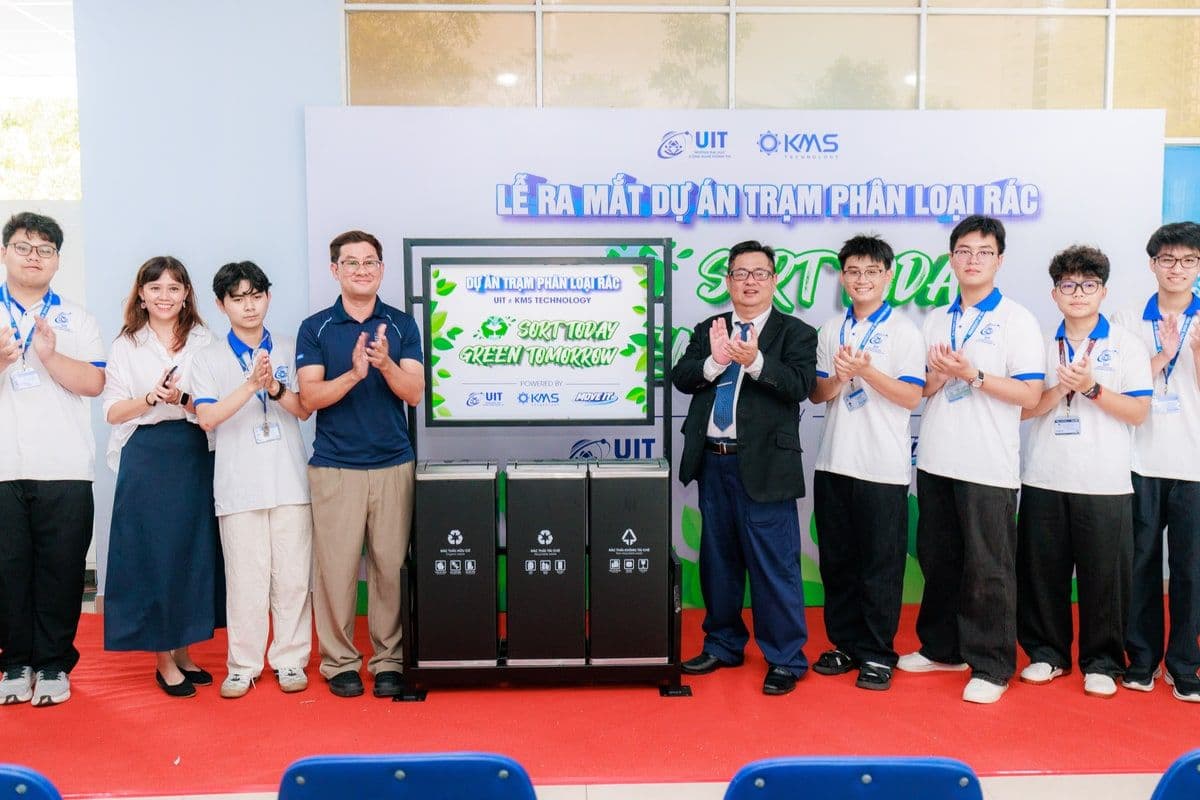
UIT x KMS Technology Green Sorting Stations: A Greener Choice for Every Day on CampusOn September 4, 2026, the University of Information Technology, Vietnam National University Ho Chi Minh City (UIT), in collaboration with KMS Technology, held the inauguration ceremony for the UIT x KMS Technology Green Sorting Station Project. With the message “Sort Today. Green Tomorrow,” the project officially began operating across the UIT campus.Representing KMS Technology at the ceremony was Mr. Tran Duc Duy, Communications Director of KMS Technology. Representing UIT were Assoc. Prof. Dr. Nguyen Tan Tran Minh Khang, Secretary of the Party Committee and President of UIT, along with faculty members and students.The Green Sorting Station Project was developed to make waste sorting more accessible and convenient for students as part of their everyday campus life. Each station features clear, easy-to-recognize signage for different waste categories, including recyclables, organic waste, and general waste.Speaking at the ceremony, Assoc. Prof. Dr. Nguyen Tan Tran Minh Khang highlighted the importance of practical actions in creating a greener and more sustainable learning environment. He shared: “The modern and well-designed green sorting stations across the UIT campus will contribute to a more civilized and environmentally responsible learning environment. We sincerely thank KMS Technology for partnering with UIT on this meaningful project, bringing practical improvements to our campus while inspiring a greener lifestyle among our students.”From today, the sorting stations will become part of the daily learning and campus experience of UIT students. The project also provides dedicated collection points for electronic waste, including used batteries, electronic components, computer mice, keyboards, earphones, cables, and damaged electronic devices.From the industry partner’s perspective, Mr. Tran Duc Duy, Communications Director of KMS Technology, shared the company’s aspiration to bring sustainable practices closer to students: “Through the Green Sorting Station Project, KMS hopes to accompany UIT in creating a greener and more sustainable educational environment for the young talents studying at the University.”Beyond transforming the campus environment, the project aims to encourage new habits among UIT students, making waste sorting a natural part of everyday life. Representing UIT students, Bui Dang Nhat Nguyen shared: “The presence of waste sorting stations across the campus serves as a reminder for every UITer to develop the habit of sorting waste and embrace a more environmentally responsible lifestyle. Through small individual actions, every member of the UIT community can contribute to our shared commitment to a greener environment.”KMS Technology’s partnership in this project further strengthens the connection between the University and industry, extending beyond technology to initiatives that create positive value for the community and the environment.“SORT TODAY. GREEN TOMORROW.”A small action can become a new habit. And when that habit is practiced every day across the UIT community, small changes can come together to create a greener and more sustainable campus.


UIT x AvePoint: Promoting a Green Lifestyle, Building a Sustainable Learning Environment
05-09-2026
On the morning of September 4, 2026, the University of Information Technology, Vietnam National University Ho Chi Minh City (UIT) held an inauguration ceremony for the UIT x AvePoint drinking water station system, officially putting the new facilities into service for students. Sponsored by AvePoint, the project provides students with greater access to drinking water while enhancing everyday amenities across the UIT campus.Representing AvePoint at the ceremony were Mr. Harry Li, AvePoint Vietnam Country Manager, and Ms. Jasmine Dinh, AvePoint Vietnam General Manager. Representing UIT were Assoc. Prof. Dr. Nguyen Tan Tran Minh Khang, Secretary of the Party Committee and President of UIT, along with representatives from the University’s units, faculty members, and UIT students.The drinking water stations have been installed at convenient locations across the campus, allowing students to easily refill their water bottles throughout the day. Beyond providing a practical campus amenity, the initiative encourages students to bring reusable bottles and gradually reduce their reliance on single-use plastic bottles.At the ceremony, representatives of UIT and AvePoint jointly performed the ribbon-cutting ceremony, officially inaugurating the new drinking water station system. Representatives from both sides then used the stations for the first time, marking the beginning of their everyday use as part of UIT’s learning and campus environment.Through this initiative, UIT and AvePoint aim not only to provide a practical facility for students but also to inspire simple, environmentally friendly habits across the UIT community. Each refill and each reusable bottle can be a small step toward reducing plastic waste and fostering a greener, more sustainable campus.The UIT x AvePoint drinking water station system also reflects the shared commitment of the University and its industry partner to creating a student-centered learning environment where technology, community well-being, and sustainability go hand in hand.SDG 4 – Quality Education

UIT EXPANDS EDUCATIONAL COOPERATION TO SUPPORT THE DEVELOPMENT OF LAOS’ INFORMATION TECHNOLOGY WORKFORCE
29-08-2026
On August 25, 2026, in Vientiane, Lao PDR, University of Information Technology, Vietnam National University Ho Chi Minh City (UIT) participated in the signing ceremony of a Memorandum of Understanding (MoU) on the implementation of an Information Technology Scholarship Program with the Department of International Cooperation under the Lao Ministry of Education and Sports and Star Telecom Company (Unitel), a joint venture between Viettel Group (Vietnam) and the Lao Ministry of National Defence.The signing ceremony was attended and witnessed by H.E. Nguyen Minh Tam, Ambassador Extraordinary and Plenipotentiary of the Socialist Republic of Vietnam to the Lao People’s Democratic Republic; Mr. Sengphet Bounlavong, representative of the Department of International Cooperation, Lao Ministry of Education and Sports; Ms. Nguyen Thi Tam, General Director of Star Telecom Company (Unitel); and representatives of relevant agencies and organizations.Representing UIT were Assoc. Prof. Dr. Nguyen Tan Tran Minh Khang, Rector of University of Information Technology, Vietnam National University Ho Chi Minh City, and members of the University delegation.At the ceremony, representatives of the Department of International Cooperation under the Lao Ministry of Education and Sports, Star Telecom Company (Unitel), and UIT signed the Memorandum of Understanding, paving the way for the implementation of the scholarship program and enhanced cooperation in developing high-quality information technology human resources for Laos.Through this partnership, UIT continues to leverage its strengths in information technology education and research while fostering connections among government agencies, higher education institutions, and industry partners. The collaboration is expected to create more opportunities for Lao students to pursue their studies, engage in research, and develop professional expertise in a high-quality higher education environment.The signing ceremony also marks a meaningful milestone in strengthening educational cooperation between Vietnam and Laos, contributing to the enduring friendship and close ties between the two countries through knowledge, technology, and the younger generation.

FROM UIT TO SINGAPORE AND INDONESIA: 18 DAYS TO SEE THE WORLD FROM A WIDER PERSPECTIVE
18-08-2026
“I packed 20 kilograms of luggage for 18 days, but came home carrying far more than I had brought.”In July 2026, Huynh Ngoc Bao, a student from the Faculty of Computer Science at the University of Information Technology, Vietnam National University Ho Chi Minh City (UIT), embarked on a journey to Singapore and Indonesia to participate in the ASEAN Summer @NTU Programme 2026.Eighteen days, two countries, two learning environments, and friendships with people from diverse cultural backgrounds transformed an international summer program into something far more meaningful. For Bao, it became a journey that broadened his perspective on technology, deepened his understanding of the value of community, and, most importantly, showed him that young people sometimes discover their true limits only after finding the courage to step beyond them.A Journey into the UnknownBefore departing, Bao imagined that the ASEAN Summer @NTU Programme 2026 would resemble many other international academic programs: lectures, workshops, group projects, and field trips.His suitcase, limited to 20 kilograms, contained everything he would need for the next 18 days. In his mind, however, there was a mixture of excitement and uncertainty as he prepared for his first academic journey across two countries — wondering about the new environments, the people he would meet, and his own ability to adapt.Yet it was precisely those unknowns that made the journey worthwhile.His first destination was Nanyang Technological University (NTU Singapore), where Bao explored topics ranging from the circular economy and renewable energy to smart cities through lectures, workshops, and experiential learning activities.Subjects that initially seemed distant from computer science gradually became relevant when placed in the context of real-world challenges: How can waste become a raw material for new products? What role could water-based batteries play in future energy systems? How can reinforcement learning enable air-conditioning systems to operate more intelligently and efficiently?Bao began to realize that the knowledge he was acquiring did not exist in isolation within a single discipline.An algorithm could contribute to energy efficiency. Data could reshape how a city operates. A technological solution could create environmental and social impacts far beyond its original technical purpose.The question was no longer simply, “How does this technology work?”It became, “What problem can this technology solve for people?”That marked the first significant shift in how Bao viewed the field he had chosen to pursue.From Singapore to Yogyakarta: Two Places, Two Approaches to Creating ChangeIf Singapore showed Bao how science and technology could be deployed within a highly developed urban environment, his next destination — Yogyakarta — offered a very different perspective on innovation.At Universitas Gadjah Mada (UGM), the learning journey continued, but in a new context. Through experiential activities and an exploration of local waste-management practices, Bao observed how environmental challenges could be addressed by solutions rooted in the needs and resources of local communities.The contrast between the two destinations left a strong impression on him.In Singapore, Bao witnessed the power of technology, infrastructure, and the ability to implement solutions at scale. In Yogyakarta, he discovered the strength of grassroots initiatives — solutions shaped by everyday realities and driven by direct community participation.Though seemingly different, the two experiences ultimately led to the same question: What makes a solution truly sustainable?For Bao, the answer gradually became clearer. A solution does not necessarily need to be highly complex or built on the most advanced technology to create meaningful impact. What matters is whether it fits the local context, addresses the right problem, and is accepted by the community it is designed to serve.From lectures at NTU to community-based experiences in Yogyakarta, Bao began to see more clearly the connection between technology and people. Technology may provide the tools to solve problems, but human needs and social contexts ultimately determine whether those tools can create genuine value.For a Computer Science student, this was a lesson that extended far beyond the 18 days of the summer program. It could influence how he approaches the design and development of technology products in the years ahead.When Strangers Become Part of the JourneyHad the ASEAN Summer @NTU Programme 2026 consisted only of lectures and field trips, it would still have been a memorable academic experience.What made the journey truly special for Bao, however, were the people he met along the way.On the first day, they arrived as strangers. Each person brought a different academic background, culture, communication style, and set of experiences.Gradually, those differences became bridges rather than barriers.They worked together to solve problems, debated ideas, divided responsibilities for group projects, and learned to reach common ground despite approaching the same issue from different perspectives.Skills that might seem familiar — communication, teamwork, active listening, and critical thinking — took on entirely new dimensions in a multicultural environment.Bao learned not only how to express his ideas clearly enough for others to understand, but also how to listen carefully enough to understand why someone else might see the same problem from an entirely different perspective.And friendships were built far beyond the classroom.There were days spent exploring Singapore and Yogyakarta together, cultural exchanges, outdoor activities, shared meals, and conversations that were never part of the official schedule.They talked about their universities, hometowns, daily lives, and aspirations for the future. Through these ordinary conversations, a much larger world gradually unfolded before Bao — not through maps or textbooks, but through the people sitting beside him.At that point, an “international experience” was no longer simply about a Vietnamese student studying in Singapore or Indonesia.It was about learning how to live, study, and work alongside people whose backgrounds and perspectives were different from his own.You Do Not Have to Be Perfect Before Stepping into the WorldThe 18-day journey also gave Bao an opportunity to reflect on himself.In an international environment, young people may easily feel that they are not skilled enough, confident enough, or sufficiently prepared. But with each day of learning and new experiences, Bao came to realize that no one needs to know everything before taking the first step.“You don’t have to wait until you are perfect before stepping into an international environment. What matters more is taking initiative, being willing to learn, adapting to change, and having the courage to step outside your comfort zone.”The knowledge and skills Bao had developed during his studies at UIT provided a strong foundation for participating in academic activities and collaborative projects. The international environment, however, placed those capabilities in an entirely new context — one that required him to take greater initiative, adapt more quickly, and remain open to learning from those around him.What Bao brought home, therefore, was not the feeling that he had somehow become “good enough” after 18 days.Instead, he returned with a clearer understanding of what he still needed to improve — and greater confidence that those gaps could be filled through continued learning and experience.Perhaps this is also one of the most important values that international learning opportunities can offer UIT students. Each journey does more than add another destination to the map. It places students in an environment different enough to encourage them to reassess their abilities, perspectives, and aspirations.The Suitcase HomeAfter 18 days, the journey came to an end.The lectures concluded. Group projects were completed. Field trips became photographs stored on phones. Friends who had studied and explored two cities together returned to their own universities, countries, and individual paths.Bao returned to Vietnam as well.His suitcase could still carry no more than 20 kilograms, but what he brought home with him was far greater than what he had packed at the beginning.He returned with a broader perspective on technology — one in which a Computer Science student looks beyond algorithms and systems to consider the people and social impact behind every technological solution.He returned with lessons from two destinations: Singapore demonstrated the power of technology and solutions implemented at scale, while Yogyakarta showed how community-driven initiatives can also create meaningful and lasting change.He returned with friendships formed among people who had once been complete strangers, along with greater confidence in his ability to learn, adapt, and connect in an international environment.Above all, he returned with a new understanding of what it means to step outside one’s comfort zone: there is no need to wait until everything is perfect before beginning.The ASEAN Summer @NTU Programme 2026 lasted only 18 days. But the lessons from Bao’s journey through Singapore and Indonesia are likely to remain with him for much longer.Because sometimes, the greatest value of a journey is not measured by how far we travel.It is measured by how differently we see the world — and ourselves — when we return.

NTU Expert Shares Emerging Research Trends in Artificial Electromagnetic Materials at UIT
18-08-2026
On the morning of August 3, the Faculty of Computer Engineering at the University of Information Technology, Vietnam National University Ho Chi Minh City (UIT) hosted a seminar entitled “Sensing, Tracking, and Secured Communication with Artificial Electromagnetic Materials.” The seminar featured Assoc. Prof. Chung-Tse Michael Wu from the Department of Electrical Engineering, National Taiwan University (NTU). An internationally recognized expert in applied electromagnetics and electromagnetic metamaterials, Assoc. Prof. Wu offered in-depth insights into integrated circuit design, artificial electromagnetic materials, and their potential applications in next-generation sensing, radar, and communication systems. The seminar was also attended by Assoc. Prof. Nguyen Binh Duong, lecturer at the School of Electrical Engineering, International University (IU). Representing UIT were Assoc. Prof. Trinh Le Huy, Head of the Integrated Circuit Design and Programmable Hardware Department, Faculty of Computer Engineering, along with faculty members from the Faculty of Computer Engineering.Assoc. Prof. Chung-Tse Michael Wu – Expert from National Taiwan UniversityOpening the seminar, Assoc. Prof. Wu introduced the fundamentals of metamaterials, with particular emphasis on composite right/left-handed (CRLH) transmission-line structures and leaky-wave antennas. These structures enable frequency-dependent control over electromagnetic wave propagation and radiation direction, allowing systems to scan beams from backward to forward directions without mechanical steering mechanisms or complex phase-shifting networks. One of the seminar’s key highlights was the application of metamaterial antennas to multi-target sensing and tracking. Assoc. Prof. Wu presented systems capable of locating objects, tracking motion, and estimating the distances of multiple objects or individuals positioned in different directions. Of particular interest, non-contact radar technology integrated with metamaterial antennas can simultaneously measure respiration, heart rate, and subtle body movements, opening up significant opportunities for healthcare, safety monitoring, and intelligent systems. The seminar also explored the design of analog and radio-frequency integrated circuits for vital-sign radar sensing. One notable example was a W-band self-injection-locked (SIL) radar sensor fabricated using 0.1-µm GaAs pHEMT technology. The sensor integrates an 85.09-GHz oscillator, a directional coupler, and an on-chip substrate-integrated waveguide (SIW) monopole antenna. Consuming approximately 56 mW with a chip area of around 12 mm², the system can perform non-contact respiration and heartbeat monitoring at distances of up to 0.9 meters. By integrating the antenna and radar circuitry on a single GaAs platform, the design reduces overall system size, complexity, and power consumption. It also demonstrates the considerable potential of analog and RF integrated-circuit technologies for compact, high-performance biomedical sensing devices.Illustration of the Self-Injection-Locked (SIL) Radar SensorThe seminar further introduced several advanced radar architectures, including homodyne and super-regenerative oscillator designs. The super-regenerative oscillator architecture, in particular, offers advantages in improving sensitivity, mitigating DC offset, and enabling vital-sign measurements over longer distances. Beyond sensing and radar technologies, the discussion expanded to emerging research directions involving space-time-coded metamaterial antennas, harmonic beam steering, nonreciprocal wave propagation, and highly secure directional communications. Through Assoc. Prof. Wu’s insights, the seminar highlighted the growing convergence of antenna technology, radar, communications, signal processing, and artificial intelligence in the development of next-generation electromagnetic systems. Assoc. Prof. Trinh Le Huy Presents a Souvenir to Assoc. Prof. Chung-Tse Michael WuThe seminar provided UIT faculty members, researchers, and students with an opportunity for academic exchange and exposure to cutting-edge research developments worldwide, while also opening up new prospects for international research collaboration.The event also reflected the Faculty of Computer Engineering’s and UIT’s broader commitment to advancing research, strengthening international collaboration, and developing highly qualified human resources equipped to meet the evolving demands of information technology and related high-tech fields.

UIT Welcomes Associate Professor Chung-Tse Michael Wu: Strengthening Academic Collaboration with National Taiwan University
01-08-2026
University of Information Technology (UIT), Vietnam National University Ho Chi Minh City (VNU-HCM), is pleased to welcome Associate Professor Chung-Tse Michael Wu from the Department of Electrical Engineering at National Taiwan University (NTU), Taiwan, for a series of academic activities, including a distinguished seminar, research discussions, and meetings with UIT research groups. The visit reflects UIT's continued commitment to internationalization by expanding global research partnerships and fostering academic excellence through collaboration with leading scholars worldwide. As Taiwan's top-ranked university and one of Asia's premier research institutions, National Taiwan University (NTU) maintains an outstanding reputation for academic excellence and innovation. Hosting internationally recognized scholars such as Associate Professor Chung-Tse Michael Wu represents an important step in UIT's strategy to strengthen research collaboration, promote academic exchange, and provide faculty members, researchers, graduate students, and students with access to cutting-edge scientific developments and emerging technologies. Associate Professor Chung-Tse Michael Wu is an internationally recognized expert in applied electromagnetics, antennas, microwave and millimeter-wave components, monolithic microwave integrated circuits (MMICs), RF systems, and electromagnetic metamaterials. He received his Bachelor's degree in Electrical Engineering from National Taiwan University in 2006 before earning both his Master's and Ph.D. degrees in Electrical Engineering from the University of California, Los Angeles (UCLA), USA. Prior to joining National Taiwan University in 2024, Professor Wu served on the faculties of Wayne State University and Rutgers University in the United States, where he was promoted to Tenured Associate Professor in 2022. Throughout his academic career, he has established an outstanding record of research, teaching, and international collaboration in advanced electromagnetic technologies. Beyond his extensive research contributions, Professor Wu actively serves the international engineering community. He is a member of the IEEE MTT-28 and IEEE MTT-4 Technical Committees, Vice Chair of the IEEE Princeton Central Jersey AP/ED/MTT Chapter, and an Associate Editor for several IEEE international journals. His distinguished achievements have been recognized through numerous prestigious honors, including the U.S. National Science Foundation (NSF) CAREER Award, the DARPA Young Faculty Award, the DARPA Director's Fellowship Award, and the Board of Trustees Research Fellowship for Scholarly Excellence. As part of his visit to UIT, Professor Wu will deliver a seminar entitled:"Sensing, Tracking, and Secured Communication with Artificial Electromagnetic Materials" The seminar will present the latest advances in electromagnetic metamaterials and their applications in intelligent sensing, motion tracking, vital sign monitoring, microwave imaging, real-time beamforming, and secure wireless communications. These rapidly evolving research areas are attracting significant international attention and hold tremendous potential for next-generation sensing, telecommunications, and intelligent wireless systems. In addition to the seminar, Professor Wu will engage in in-depth discussions with researchers from UIT's TTLab, sharing insights into building high-impact research groups, exploring emerging research directions, and identifying opportunities for future collaborative projects. He will also visit several of UIT's research facilities, including Laboratory B5.08, where he will learn about the ORB Mini system and ongoing research initiatives conducted by the University. Through international academic exchanges and strategic global partnerships, UIT continues to strengthen its research ecosystem and deepen collaboration with leading universities and scientific institutions worldwide. These initiatives play a vital role in enhancing educational quality, advancing innovation, and creating greater opportunities for faculty members, researchers, graduate students, and students to participate in international research projects, access frontier technologies, and thrive in an increasingly interconnected global academic environment. Event InformationTime: 08:45 – 09:45, 3/8/2026Venue: Room C110, University of Information Technology (UIT), Vietnam National University Ho Chi Minh City (VNU-HCM) University of Information Technology cordially invites faculty members, researchers, graduate students, and students to attend the seminar, engage in academic discussions, explore the latest technological advances, and connect with an internationally distinguished scholar.