
Study - Research




UIT Data Science Challenge 2023: Recap of the Closing Ceremony and Award Presentation
23-11-2023
On the morning of November 11, the Closing Ceremony and Award Presentation of the UIT Data Science Challenge 2023 were successfully held at the University of Information Technology. The event was graced by the presence of:
Assoc. Prof. Dr. Nguyen Tan Tran Minh Khang - Vice President of VNUHCM-University of Information Technology.
Assoc. Prof. Dr. Nguyen Luu Thuy Ngan - Vice President of VNUHCM-University of Information Technology.
Assoc. Prof. Dr. Nguyen Gia Tuan Anh - Dean of the Faculty of Information Science and Technology, VNUHCM-University of Information Technology and Head of the Organizing Committee.
MSc. Nguyen Van Kiet - Vice Head of the Faculty of Information Science and Engineering, VNUHCM-University of Information Technology and Deputy Head of the Organizing Committee.
The Organizing Committee sincerely expresses gratitude for the valuable contributions of the respected judges from Panel A and the Professional Council from Panel B:
Assoc. Prof. Dr. Nguyen Luu Thuy Ngan - Vice President of the VNUHCM-University of Information Technology.
Prof. Assoc. Dr. Nguyen Thanh Binh - Head of the Department of Applied Informatics, Faculty of Mathematics - Informatics, University of Science, VNU-HCM.
Assoc. Prof. Dr. Nguyen Gia Tuan Anh - Dean of the Faculty of Information Science and Engineering, VNUHCM-University of Information Technology.
MSc. Nguyen Van Kiet – Deputy Dean of the Faculty of Information Science and Engineering, VNUHCM-University of Information Technology, and Deputy Head of the Organizing Committee.
Assoc. Prof. Dr. Do Trong Hop - Vice Head of the Information Security Laboratory, University of Information Technology, VNU-HCM.
Assoc. Prof. Dr. Duong Viet Hang - Lecturer at the Faculty of Computer Science, VNUHCM-University of Information Technology
MSc. Tran Quang Minh Tan - Director of the Software and Data Center, FPT Software Ho Chi Minh.
Mr. Dao Van Tien Dung - Head of the Data Science Department, TMA Technology Group.
The event also saw the presence of representatives from sponsoring companies and enterprises who accompanied and supported the competition:
Representative of MEC Company (Matsusaka E.D.P Center Co., Ltd): Mr. Shibahara - General Director of MEC INFOTECH VIETNAM.
Representative of Fujinet Joint Stock Company: Mr. Nguyen Van Trung - Head of Recruitment and Training Department.
Representative of FPT Software Ho Chi Minh Company Limited: Mr. Vu Thanh Tuan - Head of Recruitment Department.
Representative of TMA Technology Group: Mr. Dao Van Tien Dung - Head of the Data Science Department.
At the Award Ceremony, congratulations were extended to the winners from both categories:
Panel A: Data Science Solutions for Smart Cities
First Prize: Team GreenJackpot
Project: ENVI WHISPER.
Members: Dang Huu Phat (VNUHCM – University of Information Technology), Vo Ngoc Minh Anh, Nguyen Quoc Dai, Huynh Van Hieu (VNUHCM – University of Science), Ma Truong Vu. (VNUHCM – University of Technology)
Second Prize: Team Mecognize
Project: Application of Medicine Name Recognition from Electronic Prescriptions using OCR methods.
Members: Bui Van Hung, Nguyen Nhat Cuong, Nguyen Thi Ngoc Dieu, Nguyen Thai Binh, Bui Ngoc Chinh. (VNUHCM – University of Science),
Third Prize: Team DiHo
Project: Enhancing Verification Capabilities for Vietnamese Information on Digital News Sites.
Members: Tran Thai Hoa, Tran Quang Duy. (VNUHCM-University of Information Technology)
Encouragement Prize: Team EFGH
Project: Government Service Q&A.
Members: Nguyen Ba Dai, Nguyen Thi Thuy, Tran Tuan Kiet, Nguyen Hoang Hy. (VNUHCM-University of Information Technology)
Panel B: Data Science Competition - Information Verification
First Prize: Team DS@UIT - Multimodal Team
Members: Nguyen Van Quan, Nguyen Kien Bao Thang, Tran Quang Dan, Pham Quang Huy. (VNUHCM-University of Information Technology)
Second Prize: Team URA_FNU
Members: Luu Chan Hung, Tran Ngoc Oanh, Le Quoc Bao, La Cam Huy, Nguyen Dac Hoang Phu. (VNUHCM – University of Technology)
Third Prize: Team Plain Sailing
Members: Nguyen Hoang Quy, Nguyen Truong Minh Van. (VNUHCM-University of Information Technology)
Encouragement Prize: Team ViNSV
Members: Tran Thai Hoa, Tran Quang Duy. (VNUHCM-University of Information Technology)
Encouragement Prize: Team Tech Warriors
Members: Nguyen Minh Tien, Ho Anh Khoi, Nguyen Minh Tue (VNUHCM-University of Information Technology), Pham Nguyen Duc Huy (University of Industry).
Encouragement Prize: Team IUH.AI Faster Bias
Members: Nguyen Van Nam, Tran Ky, Tran Xuan Dien, Duong Van Tai, Hoang Tien Anh.
Encouragement Prize: Team Peppa Research
Members: Le Tuan Hung, Nguyen Trong Manh, To Truong Long, Le Thanh Phong, Nguyen Thanh Nhi (VNUHCM-University of Information Technology).
Image Link: https://uithcm-my.sharepoint.com/personal/20520657_ms_uit_edu_vn/_layouts/15/AccessDenied.aspx?Source=https%3A%2F%2Fuithcm%2Dmy%2Esharepoint%2Ecom%2Fpersonal%2F20520657%5Fms%5Fuit%5Fedu%5Fvn%2F%5Flayouts%2F15%2Fonedrive%2Easpx%3Fid%3D%252Fpersonal%252F20520657%255Fms%255Fuit%255Fedu%255Fvn%252FDocuments%252FNGUYEN%252F%25C4%2590%25E1%25BB%2593ng%2520b%25E1%25BB%2599%2520%25C4%2591%25E1%25BB%2583%2520share%252FDSC2023%2520%252D%2520%25E1%25BA%25A2nh%2520L%25E1%25BB%2585%2520T%25E1%25BB%2595ng%2520k%25E1%25BA%25BFt%2520v%25C3%25A0%2520Trao%2520gi%25E1%25BA%25A3i%26ga%3D1&correlation=15f7f0a0%2D805d%2D2000%2Dbb22%2D46d6d4e7d5fe&Type=item&name=f0691f65%2D7151%2D46c4%2Dab3a%2D3d1faed68754&listItemId=34235&listItemUniqueId=8f5c1b2d%2D1a54%2D4580%2Dae54%2Da4b4e8c3dd57
Detailed Information: https://www.facebook.com/uit.dsc/posts/pfbid0RuzdhPSWgAJgrr22YodS4vekrc9cVw7RehQiZgoFka8Qo8vKab1yJ7VFyU5K72AZl
Đông Xanh - Communication Collaborator, University of Information Technology
English version: Phan Huy Hoang

The Data Science student group has a paper accepted for presentation at the IEEE International Conference on Data Science and Advanced Analytics (IEEE DSAA)
20-11-2023
Paper Title: "MAT: Effective Link Prediction via Mutual Attention Transformer"
Contributing Students:
Nguyen Van Quan – 21521333 – Data Science – Primary Author.
Pham Quang Huy – 21522163 – Data Science – Co-author.
Tran Quang Dan – 21521917 – Data Science – Co-author.
Nguyen Kien Bao Thang – 21521432 – Data Science - Co-author.
Supervising Instructor: Mr. Nguyen Hieu Nghia.
Paper Summary:
The DSAA (Data Science and Advanced Analytics) 2023 is part of the DSAA 2023 conference. The challenge aims to explore effective approaches to determine whether a link exists between two Wikipedia pages. Specifically, given a pair of nodes (u, v) along with information about each node, the main objective is to ascertain whether there is a link between the two nodes, where label 1 represents "yes" and label 0 represents "no." The final decision will be based on the effectiveness of the method (scores), performance (time required for training and testing), and the novelty of the proposed method.
By successfully predicting the presence or absence of a link, we contribute to discovering connections and underlying relationships in the Wikipedia network. The results of this task are crucial for various applications such as network reconstruction, recommendation, and understanding the network's evolution.
In this paper, we present the Vanilla Fully Connected (VFC) method and the Mutual Attention Transformer (MAT) method. The VFC method uses only ID information, while the MAT method can utilize both ID and text information of both nodes. Based on the competition results, we can confidently state that both VFC and MAT are effective in addressing the challenges posed in the DSAA Challenge 2023.
The IEEE International Conference on Data Science and Advanced Analytics (IEEE DSAA) is a leading data science forum supported by IEEE, ACM, ASA, and CCF. DSAA is recognized by the CORE and CCF conference rankings, ranking in the top 20 for data mining and analysis in Google Metrics. DSAA holds a high position with program chair/host seats, outstanding keynote speakers, interdisciplinary participation, and cross-domain involvement in statistics, computer science, computing, industry, and government, as well as the Next Generation Data Scientist Award.
Further information: https://www.facebook.com/UIT.Fanpage/posts/pfbid037EQsBUzwZujeiANncgpgse9PodYkKjajLVmhZXyrvMpt7VwV1ymuifdWiQjbeJr5l
Written by: Hai Bang
Translated by: Ngoc Diem
Student Nguyen Xuan Quang, a second-year student, has had a scientific paper accepted for publication at the FAIR 2023 Science Conference.
15-11-2023
Title: "Object Detection in Aerial Images Using the Oriented RepPoints Method."
Student researcher: Nguyen Xuan Quang – Majoring in Software Engineering 2022.3 – Primary Author
Supervisors:
Assoc. Prof. Dr. Nguyen Tan Tran Minh Khang
MSc. Ta Viet Phuong
Abstract:
Object detection in aerial images has recently attracted significant attention, playing a crucial role in identifying objects at a distance from an aerial perspective. Unlike images collected at ground level, objects in aerial images are often not aligned along axes and can have arbitrary orientations. In this paper, we have researched and evaluated the Oriented RepPoints method. This method leverages the representation of adaptive points to capture important geometric features of arbitrarily oriented objects distributed with high density in complex contexts. Extended experiments were conducted on the SODA-A dataset, providing additional useful information for further research.
"We sincerely express our gratitude to the Faculty of Software Engineering, Multimedia University, and the UIT-Together research group for creating conditions that allowed us to research and complete this paper."
In order to contribute to the promotion of basic and applied research in Information Technology in Vietnam, the Vietnam Union of Science and Technology Associations, the Vietnam Academy of Science and Technology, in collaboration with the University of Technical Education - University of Danang, and various scientific institutions and researchers from research institutes and universities, organize the 16th National Conference on "Fundamental and Applied Information Technology" (FAIR'2023). The main theme of the conference is "Data Science in Digital Transformation."
The conference takes place at the University of Technical Education - University of Danang over two days: Thursday and Friday, September 28-29, 2023.
For more detailed information: https://www.facebook.com/UIT.Fanpage/posts/pfbid0cT2P45YT4n2BwwiuVTz3yHCFLy3kLSLuXP4MQ1kqTHguXw6634hKRsHV5qkmgQqKl
Written by: Hai Bang
Translated by: Ngoc Diem

UIT Student Group's Scientific Paper Accepted at FDSE 2023 Scientific Conference
14-11-2023
Paper Title: "Evaluate the efficiency of a hybrid model based on Convolutional Neural Network and Long Short-Term Memory in Information Technology Job Graph Network"
Student Contributors:
Nguyen Minh Nhut – 17520867 –HTCL2017 – Co-author.
Dang Minh Quan – 19520867 – HTCL2019 – Co-author.
Le Mai Duy Khanh – 19521679 – HTCL 2019 – Co-author.
Supervising Teacher: Assoc. Prof. Dr. Nguyen Dinh Thuan
Paper Summary:
The advancement of technology has positively impacted society's lifestyle, providing more job opportunities. This may influence the career decisions of information technology students regarding their future professions. To help IT students in Vietnam and neighboring countries connect and interact with employers to find employment, we developed the ISCV application using Smart Contracts in Blockchain technology to facilitate connections and store information. We also utilized several machine learning algorithms, including Convolutional Neural Network (CNN), Long Short-Term Memory (LSTM), Bidirectional Long Short-Term Memory (BiLSTM), to create a proposed system that can assist individuals in choosing jobs that match their skills and capabilities. Furthermore, we proposed a hybrid model combining Convolutional Neural Network (CNN) with Long Short-Term Memory. The Hybrid CNN-LSTM model leverages the feature extraction capability of CNN from input data and the sequential learning ability of LSTM. Training and testing datasets were collected from job search websites. We used classification performance metrics, including Accuracy, Recall, Precision, and Micro-F1, to evaluate the models' performance. The final experimental results demonstrate that the Hybrid CNN-LSTM model has the highest accuracy.
"We would like to express our gratitude to Assoc. Prof. Dr. Nguyen Dinh Thuan – Dean of the Faculty of Information System for his dedicated guidance and for pointing out our limitations during the research and publication of this international scientific paper."
The 10th International Conference on Future Data and Security Engineering (FDSE) is a leading forum designed for researchers and students interested in advanced and practical activities related to data, information, knowledge, and security technologies. The conference aims to explore advanced ideas, present and exchange research results, and discuss new issues in data, information, knowledge, and security technologies. At FDSE, researchers and students can share research solutions for current societal issues in security and data and identify new directions for related research and development work in the future.
FDSE Proceedings are indexed in Scopus, EI Compendex, DBLP, and listed in the Conference Proceeding Citation Index (CPCI) by Thomson Reuters.
For more information, please visit:
https://www.facebook.com/UIT.Fanpage/posts/pfbid0o3KyrCovRgEy4WsdUdMuUWVUAoGDhzRQ3EkRg2KaorjMB8UPHmz5WzeRuGK42zd3l
Hai Bang - Communications Collaborator, University of Information Technology
English version: Phan Huy Hoang
Congratulations to three Data Science students whose scientific paper has been accepted for publication at the VNICT 2023 scientific conference.
14-11-2023
Paper Title: "Distributed Real-time Vehicle Speed Estimation System for Vietnam Traffic Management"
Paper Link: https://drive.google.com/drive/folders/1U4pfIkZvDOD3rLXZkW9QOvQXZetUPL3i
Students involved:
Vo Tran Dai – 19521308 - KHDL2019: Lead author.
Nguyen Thi Mai Phuong – 19522064 - KHDL20192019: Lead author.
Dinh Van Co – 19521293 – KHDL20192019: Lead author.
Supervising Teacher:
Dr. Do Trong Hop
Paper Summary:
This research presents a method for estimating vehicle speeds on Vietnamese streets using deep learning and distributed streaming technology. Initially, a new dataset of traffic videos from Ho Chi Minh City was compiled. Subsequently, a novel algorithm pipeline for vehicle speed estimation was proposed. The algorithm operates by detecting and tracking the same vehicle across multiple frames and calculating its movement over time. To ensure practicality, a distributed real-time vehicle speed estimation system utilizing the proposed algorithm was developed. In this system, traffic videos from various locations are streamed to a Kafka server for processing by the vehicle speed estimation algorithm. Real-time results are then displayed on a dashboard. Experimental results demonstrate that the proposed system is not only reliable but also highly practical for deployment in traffic management in Vietnam.
"We express our sincere gratitude to Dr. Do Trong Hop, who has consistently provided strong support, guidance, advice, and direction throughout our academic journey and the completion of this research."
VNICT 2023 is the 26th National Workshop on "Selected Issues in Information Technology and Telecommunications" organized by the Institute of Information Technology - Vietnam Academy of Science and Technology and the University of Engineering and Technology - Ministry of Public Security. The event took place in Bac Ninh on October 5-6, 2023, with the collaborative participation of the Vietnam IT-Telecom Club (FISU). The workshop serves as an annual forum for researchers, practitioners, educators, and managers in the field of information technology and telecommunications to exchange academic knowledge, share practical experiences, and seek collaboration. The workshop particularly encourages young scientists, researchers, and graduate students to present and discuss their research and learning outcomes. It also promotes the exhibition of scientific and technological products and applied research results.
For more detailed information, please visit the fan page: University of Information Technology.
Dong Xanh - Communications Collaborator, University of Information Technology
English Version: Phan Huy Hoang

Two talented students, Phan Doãn Thái Bình and Lê Phước Vĩnh Linh, from the Faculty of Computer Science, have had their scientific paper accepted for publication at the SOICT 2023 scientific conference.
14-11-2023
Title of the Paper: "Domain Adaptation in Nested Named Entity Recognition From Scientific Articles in Agriculture"
Student Authors:
Phan Doãn Thái Bình – 20520043 – KHTN2020 – Main Author
Lê Phước Vĩnh Linh – 20521531 – KHTN2020 - Main Author
Supervisors:
Dr. Ngô Quốc Hưng
Dr. Lương Ngọc Hoàng
Abstract:
In the context of digital agriculture, timely and informed decision-making relies on the utilization of agricultural data, including text sources such as scientific articles. Named Entity Recognition (NER) and Agricultural Entity Recognition (AGER) play a crucial role in semantic understanding for precise identification and categorization of farming components. However, existing approaches to agricultural entity recognition face challenges due to limited resources, and the need for recognizing nested named entities arises due to the complexities in the agricultural domain.
This study introduces the SAGRI dataset, incorporating a novel tagset for AGER, systematically established through annotation. The tagset enables the extraction of domain-independent concepts from scientific article abstracts. The study also presents a state-of-the-art deep learning baseline with an advanced Triaffine attention mechanism for robust entity extraction. Additionally, it introduces a pioneering few-shot learning strategy for cross-domain categorization, particularly effective with scarce training data, achieving high F1 scores compared to the baseline.
The students express gratitude to Dr. Ngô Quốc Hưng and Dr. Lương Ngọc Hoàng for their dedicated guidance and for pointing out the limitations in their research during the process of conducting and publishing this international scientific paper.
SOICT 2023 is an international symposium covering various research areas, and the conference aims to provide an academic platform for researchers and students to share their latest findings and identify future challenges in computer science. The symposium will be held in Ho Chi Minh City on December 7-8, 2023, and the proceedings will be published in the ACM Digital Library. SOICT 2023 is organized by several institutions, including the School of Information and Communication Technology, Hanoi University of Science and Technology, and Hochiminh University of Science – Vietnam National University.
Further information: https://www.facebook.com/UIT.Fanpage/posts/pfbid09pMH91yccUKC5LR8w72kpTetfZ7iHgKMduMjSsbH2XMt34nLtrX5uawqjHnZ4s7Vl
Written by: Hai Bang
Translated by: Ngoc Diem

Free Course on Generative AI from Microsoft
12-11-2023
This article introduces a new free course on Generative AI from Microsoft Cloud Advocates. The course consists of 12 lessons covering everything you need to know to start building Generative AI applications.
Each lesson includes:
A short introductory video on the topic.
Lessons in the README file.
Jupyter Notebooks with example code for project-based learning.
Exercises to apply the knowledge gained.
Links to additional resources for further learning.
The content of the lessons includes:
Introduction to Generative AI and LLMs (Large Language Models).
Understanding and comparing different LLMs.
Using Generative AI responsibly.
Basics of Prompt Engineering technique.
Creating advanced prompts.
Building a text generation application.
Building a chat application.
Building a search application with Vector databases.
Building an image generation application.
Building a Low Code AI application.
Integrating external applications with function calls.
Designing a user interface for AI applications.
Course link: Generative AI for Beginners
For more details, visit: https://www.facebook.com/dsociety.uit.ise/posts/pfbid02yceqPLhZv2j9HSGN8...
Ha Bang - Media Collaborator, University of Information Technology
Nhat Hien - Translation Collaborator, University of Information Technology
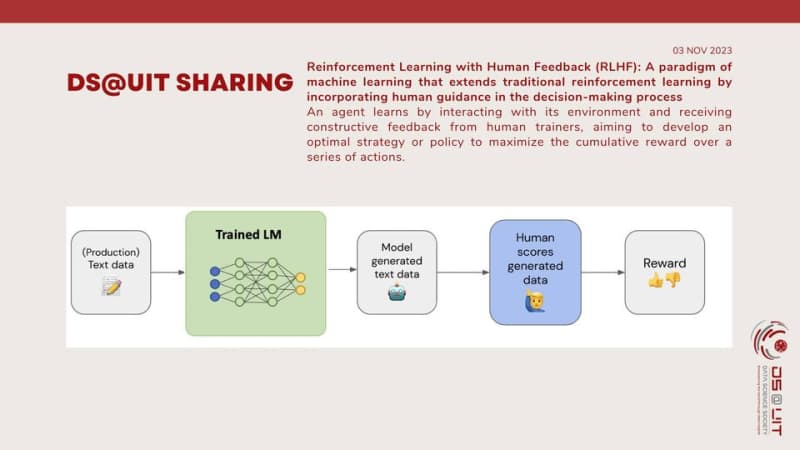
Self-learning Reinforced with Human Feedback
11-11-2023
Reinforcement Learning with Human Feedback (RLHF) represents a significant advancement in the realm of machine learning, blending the power of artificial intelligence with human expertise. In RLHF, the core idea is for an agent to learn by interacting with an environment while also receiving constructive input from human trainers. This hybrid approach bridges the gap between automated decision-making and human wisdom, creating a synergy that enhances the learning process.
Key Components of RLHF:
1. Agent: This is the entity under training, whether it's an AI-driven system, a robot, or any autonomous decision-maker. The agent is at the heart of RLHF and is responsible for learning from both the environment's rewards and the valuable insights provided by human trainers.
2. Action: Actions are the choices made by the agent to navigate and interact with its environment. The agent's actions are influenced by its past experiences, environmental cues, and human feedback.
3. Environment: The environment signifies the context or system in which the agent operates. It could be a physical space, a virtual world, or any complex system where decisions need to be made.
4. Reward and Human Feedback: One of the distinguishing features of RLHF is the inclusion of human feedback. While traditional reinforcement learning relies solely on environmental rewards, RLHF introduces human evaluative feedback. This feedback can be in the form of expert guidance, preference rankings, or direct observations. Human feedback enriches the learning process by providing nuanced guidance and real-world context.
5. Strategy: The strategy, or the sequence of actions, is the ultimate output of RLHF. It encapsulates the agent's decisions, incorporating both environment-based and human feedback-based learning. The goal is to create a strategy that maximizes rewards and aligns with human-defined objectives.
Applications of RLHF:
RLHF finds applications in various domains, where human expertise is invaluable. Here are some examples:
- Robotics: Robots can learn complex tasks with human guidance, making them more adaptable and safer in real-world scenarios.
- Autonomous Vehicles: RLHF can help self-driving cars navigate challenging situations by incorporating human guidance to improve decision-making.
- Virtual Assistants: Chatbots and virtual assistants can provide more relevant and accurate responses by leveraging human feedback to improve their natural language understanding and conversation quality.
- Healthcare: In medical diagnostics and treatment recommendations, RLHF can incorporate the knowledge and expertise of healthcare professionals to enhance patient care.
- Game Playing: RLHF can be used to create game agents that learn not just from game rewards but also from expert gamers, leading to more engaging and challenging gaming experiences.
In summary, Reinforcement Learning with Human Feedback is a powerful paradigm that leverages the strengths of both machines and humans. By fusing artificial intelligence with human wisdom, RLHF creates adaptable, intelligent systems capable of navigating complex, dynamic environments and making informed decisions that align with human goals and expertise. This approach holds the potential to revolutionize a wide range of applications and industries by enhancing the learning and decision-making capabilities of AI systems.
Further Information: https://www.facebook.com/dsociety.uit.ise/posts/pfbid02iVoTNEpHKchcZL5PtGuAKZuRwxTmk6u1uECuSVesAgZkKk6TepxQi8WXEswRWNval
Hạ Băng - Collaborative Communications Officer, University of Information Technology
Translated by Ngoc Diem
Announcement of the retake of the Midterm Exam for the First Semester of the Academic Year 2023-2024 for the General Law course.
11-11-2023
Hello students!
Due to technical issues with the exam on November 1, 2023, a retest will be organized.
Exam time: 60 minutes.
Exam structure: 10 true/false questions.
Each class will have a separate exam session during their regular class hours. Please arrange your schedule to participate in the exam.
The specific exam date, time, and room are provided in the image below.
Further Information: https://student.uit.edu.vn/thongbao/thong-bao-thi-lai-giua-ky-hk1-nh2023-2024-mon-phap-luat-dai-cuong
Hạ Băng - Collaborative Communication Officer, University of Information Technology
Translated by Ngoc Diem

The UIT student team had their scientific paper published at the MAPR 2023 Scientific Conference.
11-11-2023
Title: "Intelligent Attendance System: Combining Fusion Setting with Robust Similarity Measure for Face Recognition"
Authors:
- Che Quang Huy – 18520819 – KTMT2018 – Main Author.
- Le Huu Truyen – 20522094 – KTMT2020 – Co-author.
- Ngo Man Dat – 19521333 – MTCL2019 – Co-author.
Supervisors:
- M.S. Phan Dinh Duy
- M.S. Tran Hoang Loc
Abstract:
The attendance and timekeeping system based on facial recognition is increasingly being widely applied in classrooms or businesses. However, challenges such as prediction accuracy, effective data collection methods, and limited hardware processing time (Embedded Computer) still exist when implementing attendance systems in real-world scenarios. Most recognition methods compare specific features individually, making it impractical to use combined features for simultaneous face recognition. This paper presents an attendance system using facial recognition technology. To enhance facial recognition accuracy, intelligent data collection techniques and improvements in face detection are applied. A clustering algorithm is utilized to select relevant facial data for feature comparison in the intelligent data collection process. By optimizing face detection accuracy, we combine results across multiple frames and introduce a new method for information retrieval by combining centroid-based and instance-based distance. Logistic regression is used to determine weights for this method. We evaluate our combined method on the VN-celeb dataset, demonstrating superior accuracy (92.63% with Arcface Resnet101) compared to centroid-based (91.97%) and instance-based (91.67%) methods. Furthermore, we extend the application of our proposed attendance system to an intelligent attendance system, utilizing hardware components such as Raspberry Pi 4 and additional devices. This system is supported by infrastructure databases and a user-friendly web interface, allowing users to conveniently view attendance-related information.
"We sincerely thank Mr. Phan Dinh Duy – Associate Dean of the Computer Science Faculty and Mr. Tran Hoang Loc – Secretary of the Computer Science Faculty’s HCYU, as well as the CEEC club, for their support in creating favorable conditions for our research. Once again, we express our gratitude to both supervisors for their support, exchange, and feedback, enabling us to complete this research project to the best of our ability."
The "International Conference on Multimedia Analysis and Pattern Recognition - MAPR" is an annual international conference co-founded and organized by the University of Information Technology (UIT). This Scopus-Indexed international conference aims to promote the development of science and technology in the fields of Artificial Intelligence and Machine Learning. The conference gathers researchers and experts from both academia and industry to share the latest research results, test findings, and strengthen potential cooperation opportunities in pattern recognition, multimedia analysis, and related fields. Some topics of interest include Pattern Recognition and Machine Learning, Multimedia Analysis, Biomedical Image Analysis and Biometrics, Computer Vision and Robot Vision, Document Analysis and Recognition, Applications, etc. The 6th International Scientific Conference MAPR 2023 is organized by the University of Information Technology (UIT), in collaboration with VAPR (Vietnamese Association on Pattern Recognition), Hanoi University of Science and Technology (HUST), and Institute of Information Technology (IOIT). The conference took place in Quy Nhon, Binh Dinh, on October 5 and 6, 2023. The conference attracted many scientists, doctoral students, graduate students, and students from various countries, including the United States, France, Japan, Malaysia, and Vietnam. With its papers published on IEEE Xplore and indexed in Scopus, MAPR conference has achieved certain success in promoting the development of multimedia analysis and recognition in Vietnam and worldwide.
For more details, visit: https://www.facebook.com/UIT.Fanpage/posts/pfbid02vfC8wv8JY2w...
Hai Bang - Media Collaborator, University of Information Technology
Nhat Hien - Translation Collaborator, University of Information Technology
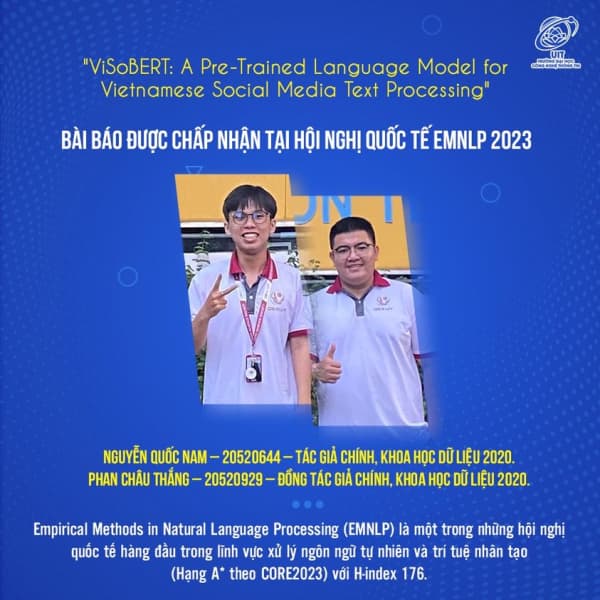
Congratulations to the UIT Data Science student for being accepted at the top international conference in Natural Language Processing and Artificial Intelligence (Ranked A* according to Core2023) with an H-Index of 176.
11-11-2023
Title: "ViSoBERT: A Pre-Trained Language Model for Vietnamese Social Media Text Processing"
Paper Link (preprint): https://arxiv.org/abs/2310.11166
Pre-trained LM Code: https://huggingface.co/uitnlp/visobert
Student Contributors:
Nguyễn Quốc Nam – 20520644 – Primary Author, Data Science 2020.
Phan Châu Thắng – 20520929 – Co-author, Data Science 2020
Supervisors:
ThS. Nguyễn Văn Kiệt
ThS. Nguyễn Đức Vũ
Summary of the Paper:
While English and Chinese, known as resource-rich languages, have seen significant development of language models for natural language processing (NLP) tasks, Vietnamese, currently the eighth most used language on the Internet with around 85 million users worldwide, still faces limitations in NLP research. Despite the availability of a large amount of Vietnamese data on the Internet, progress in Vietnamese natural language processing (NLP) research remains restricted. Several models such as PhoBERT, ViBERT, and vELECTRA have been proposed and work well on general Vietnamese NLP tasks, including POS tagging and Named Entity Recognition. However, these language models still have limitations in social media language processing and analysis of Vietnamese data. Therefore, in this paper, the authors propose the first language model for Vietnamese social media text, called ViSoBERT, pre-trained on a large, high-quality, and diverse dataset of Vietnamese social media text based on the architecture of the XLM-R model. Additionally, the authors evaluate their model on five important NLP tasks on Vietnamese social media text: emotion recognition, hate speech detection, sentiment analysis, spam reviews detection, and hate speech spans detection. To gain a deeper understanding of their language model, the team analyzes experimental results on Masking Rate, examines social media features including Icons, Teencodes, and Punctuation Marks, and deploys feature-based extraction for specific language models. Their experiments demonstrate that ViSoBERT, with fewer parameters, outperforms previous advanced models on various Vietnamese social media text tasks.
The students express deep gratitude to ThS. Nguyễn Văn Kiệt, and ThS. Nguyễn Đức Vũ for dedicating time and effort to guide and identify limitations during the research and publication of this international scientific paper.
Note: Empirical Methods in Natural Language Processing (EMNLP) is one of the top international conferences in natural language processing and artificial intelligence (Ranked A* according to CORE2023) with an H-index of 176.
Further information: https://www.facebook.com/UIT.Fanpage/posts/pfbid0bikaeBJkqHcD8Yc1h2ifxXrKr3BQERgLuswK5c2Y8qULCBMMep3EkGQNkkzh7ExYl
Hải Băng - Collaborative Communication Officer, University of Information Technology.
Translated by Ngoc Diem

Congratulations to Ph.D. student Nguyen Xuan Vinh Phu for having a scientific paper published in the Intelligent & Fuzzy Systems journal.
11-11-2023
The paper, titled "Improving sentence representation for Vietnamese natural language understanding using Optimal Transport," was the result of collaborative efforts with guidance from:
- Associate Professor Nguyen Luu Thuy Ngan
- MSc. Nguyen Van Kiet
Abstract of the paper:
Understanding Natural Language (NLU) poses a challenge in Natural Language Processing (NLP), focusing on techniques to help computers understand human language and perform tasks related to language content. In recent years, with the emergence and development of Transformer networks and pre-trained language models, significant advancements have been made in the performance of NLU tasks. Research efforts have primarily concentrated on building pre-trained models for languages with abundant resources and large datasets. However, for languages with limited resources, pre-trained models may not be optimized well due to challenges in data collection. The introduction of multilingual models has addressed this issue by extending the model's representational capabilities to various languages, leading to significant improvements in NLU tasks for languages with limited resources.
Upon reviewing existing research results on multilingual models, the student identified a drawback: performance on tasks decreases when adding more languages during pre-training. Despite having a large number of parameters, multilingual models are often not well-optimized, especially for languages with limited resources due to the large number of languages that need to be represented. In this thesis, the student aims to enhance the performance of multilingual models on Vietnamese for NLU tasks, specifically text comprehension and natural language inference. These tasks are commonly applied in practical scenarios, especially in automated question-answering systems or information extraction. However, building models to solve these tasks still presents some challenges. Vietnamese is considered a language with limited resources due to a lack of labeled datasets. Additionally, processing Vietnamese faces difficulties, especially in vocabulary and syntax ambiguity, requiring models to possess inference and information synthesis capabilities. Therefore, the student recognizes the need to propose models that improve results on these tasks.
The student expresses deep gratitude to Associate Professor Nguyen Luu Thuy Ngan, Mr. Nguyen Van Kiet, and co-author Nguyen Hoang Thien Thu for their invaluable guidance, knowledge sharing, and precious experiences throughout the paper's development.
The Intelligent & Fuzzy Systems journal focuses on applications in Advanced Engineering and Technology, promoting the application and dissemination of research results related to fuzzy logic, intelligent systems, and web-based applications across various fields. The journal is dedicated to computer science, electrical engineering, manufacturing engineering, industrial engineering, chemical engineering, mechanical engineering, civil engineering, engineering management, biotechnology, and biomedical engineering. The scope of the journal also includes the development of technologies in mathematics, research activities, technology management, technical issues, society, and the environment. The Intelligent & Fuzzy Systems journal is listed in prestigious journal databases such as SCOPUS and ISI Web of Science.
Further information: https://www.facebook.com/UIT.Fanpage/posts/pfbid0kpEmtmbWNkFxnWJyFDXUMrYXFfsa79cvhgbXSpkWGAyUUgGWd9qzLWnSmSGmAtYfl
Written by: Hai Bang
Translated: Ngoc Diem